Key Takeaways
- Balance is a lie; focus on intentionality.
- Self-leadership is crucial for business success.
- Understanding your wealth types is essential.
- Lack of self-awareness can be a bottleneck in growth.
- Working on the business is different from working in it.
- Leadership shapes organizational culture.
- Finding the right people is key to success.
- Align business strategies with personal values.
- Coaching is vital for top performance.
- Succession planning is necessary for legacy.
Summary
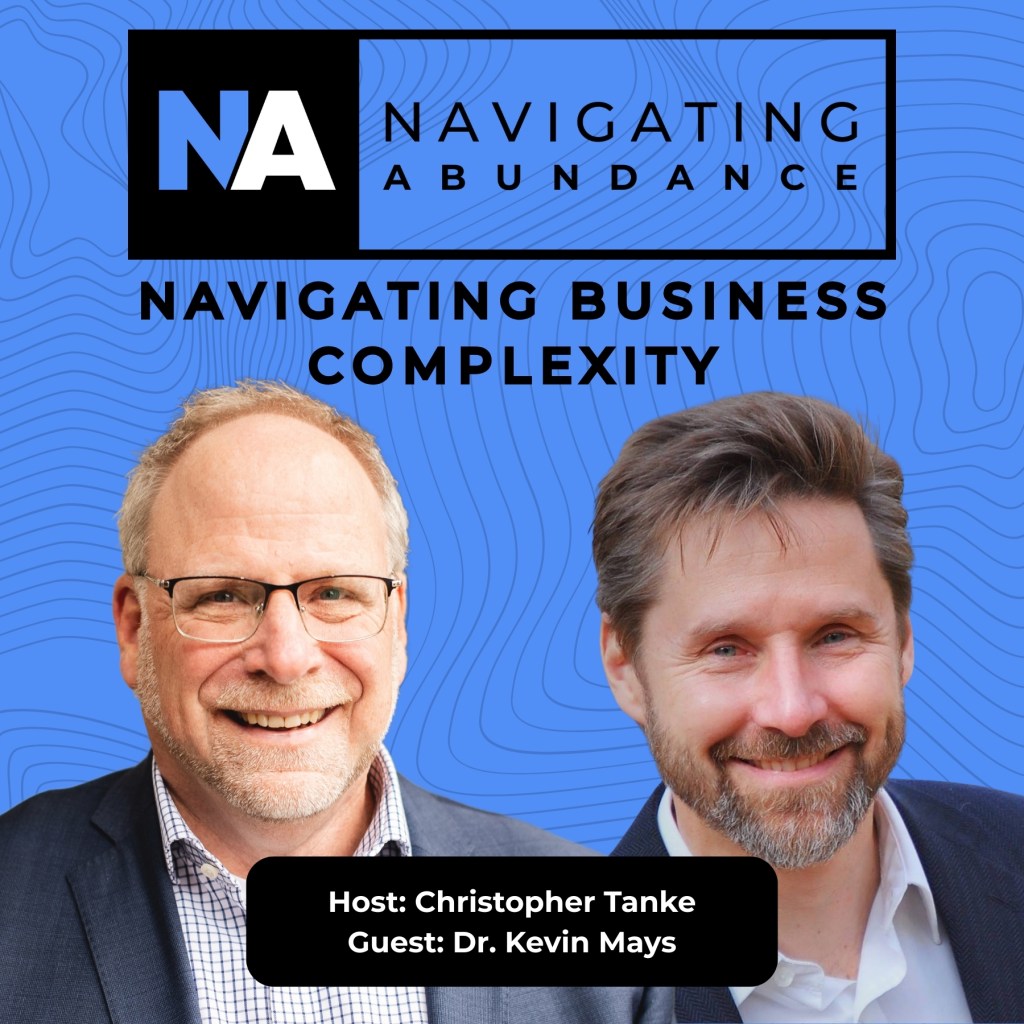
In this episode of Navigating Abundance, Chris Tanke and Dr. Kevin Mays, owner and founder of Mays Leadership, discuss the complexities of business ownership and the importance of self-leadership. They explore the myth of balance, the entrepreneurial mindset, and the necessity of intentionality in managing wealth. The dialogue emphasizes the significance of self-awareness, the distinction between working on versus in a business, and the critical role of leadership in shaping organizational culture. They also touch on the importance of finding the right people, aligning business strategies with personal values, and the value of coaching in achieving business success. Finally, they highlight the need for effective succession planning to ensure a lasting legacy.
Get your free Vision Mastery Playbook here: https://vision.maysleadership.com/
Click to Show Transcript
Chris Tanke (00:02.29)
I’m very excited again to have Kevin Mays with us today. Kevin is a business development coach of renowned in our area and, just has been around the block more than once or twice. So Kevin, welcome to the podcast.
Dr. Kevin Mays (00:19.191)
Thanks, I am fired up and excited to be here. I know we have some very common interests in how we work with business and some exciting stuff to talk about. I love and live for this stuff, so thank you.
Chris Tanke (00:30.209)
That’s fantastic. I’m very, glad to have you. You know, when a business owner starts realizing some success, with it comes complexity. And that complexity not only cascades throughout their business, it cascades down into their family. And so the overused word have balance in your life is sort of kind of what we’re talking about today. As somebody thinks about, I’m going, I want to scale this thing. How do I do this? And how do I still have control of my own life? Does that sound familiar to you?
Dr. Kevin Mays (01:07.779)
Absolutely. I love it. First of all, I want to rake the word balance over the coals. Balance is a lie. There is no balance. It’s not about balance. It’s about being intentional and having clarity of your vision. What is the business for? Is the business designed to be something that sucks up all your time, takes away your life, and separates you from your family? I’ve known some business owners who have done a magnificent job amassing lots of wealth on their third wife and their kids won’t talk to them.
That’s probably not what we’re looking for here. Well, it’s really, mean, ideally, right? A true business works without you. That’s a business. Otherwise you own a job. And the notion is not to own your job or maybe it is, but you have to decide and be intentional about it. I see too many founders.
Chris Tanke (01:40.833)
Right. Yeah. Something in between.
Chris Tanke (01:59.959)
Yeah, have to be honest about it.
Dr. Kevin Mays (02:01.635)
Yeah, yeah, too many founders, too many owners who get pulled in. The secret to their success is their ability to get stuff done. And so as the business is scaling, they’re running around with their sleeves rolled up trying to get stuff done. They’re getting in the way of their own scaling. And I’ve seen it over and over and over. And that’s the hardest thing is to let go of your baby.
Chris Tanke (02:21.035)
Yeah, for sure. Kevin, could you just give the audience a little bit of your background and a little bit about your philosophy, how you work with business owners, etc.
Dr. Kevin Mays (02:32.713)
I know at a core level that before you can lead others, you have to lead yourself first. And that means understanding what makes you tick. What are the drives you’ve inherited in your personality? So I’m a recovering psychologist, right? I’m a psychologist turned business consultant. I worked as a psychologist for a decade. I won’t say how long ago, because I don’t want to date myself. But then I got, I a worked in banking for quite a while as the executive consultant to the executives of a large bank that we took through the recession in 2006, 7, 8. That bank went from a mid-size regional bank when all the other banks were folding to become the ninth largest bank in the country and now it’s top three. And I love it. The CEO said, it’s no surprise. It’s the stuff we’re teaching, which I call conscious leadership. I believe that if you want to lead yourself or lead a business at all starts by learning how to turn your attention and your focus inward learning how to lead yourself and the reason you know the thing that really gets me fired up I grew up I’m a GM kid my dad worked for GM for 30 years 34 years so it was great it was a lifestyle I mean it was a beautiful thing that got provided to us through GM but then when GM goes belly-up I watched what happens to the infrastructure and the town and the other businesses, the restaurants, the shopping malls, the car dealers, the infrastructure of the city just turns upside down. And when I witnessed that, I made a deep commitment that…
I’m gonna do whatever I can to make sure that kind of thing never happens again. When I see my little buddy Joey and he has to move because his dad doesn’t have a job and I’m in fifth grade, it just hits ya. So that’s part of what lights the fire in me is not only all the work I love, I’m a self-awareness junkie and a doctor of leadership, but also that history of witnessing what happens when the world’s largest organization goes bankrupt.
Chris Tanke (04:17.663)
Mm.
Chris Tanke (04:36.445)
Right. When we started strategic financial group, and gosh, this is which is our registered investment advisor firm. You know, we had zero clients, we moved across state, planted a flag 17 years ago, and we were all in on this thing all in completely exposed, just took on a lot of responsibilities, took all of our equity and pushed it on the table and say we’re all in on this deal. So you know, I understand that some people would see that as risky. The way I looked at it is I didn’t want to, if I’m going to start a second career, 50, because that’s about what I was at that age. I didn’t want to work for somebody else. Um, and then for them to do something goofy or silly, and then all of sudden I’m on the street. That’s risky. Then I’m on the street at say 57, 58. Now what am I going to do? So what we did is we said, no, no, no, let’s let’s even though it sounds and feels scary at first, let’s push everything all in, believe in ourselves, build our own firm so we’re controlling our own destiny, good, bad or indifferent. That’s just kind of an entrepreneur just kind of oozing out with those kinds of concepts, is it not?
Dr. Kevin Mays (05:50.187)
Absolutely. I did exactly the same thing. I was living in North Carolina where you had and I worked for a large bank So I had the illusion of consistency and that’s what it is. It’s nothing more than an illusion and I love it We pulled out a map and said we’re gonna move to Michigan Where do you want to go and really decided same thing all the chips on the table? And as I like to say we burned the boats. There’s one option moving forward. There’s no plan B There’s one plan and that’s what’s gonna happen in my goodness We moved to a new community and I happened to launch a book the same
Chris Tanke (06:12.212)
Yep, that’s right. That’s right.
Dr. Kevin Mays (06:20.161)
time when I arrived and it just took off like a firestorm. It’s been so fantastic being able to be helpful. So I’m really excited now. This is my 10 years that we moved to Michigan and I have another book coming out so I’m very excited about that.
But I understand that the DNA of the entrepreneur, an entrepreneur has a different relationship with risk. And let’s go of the belief, the illusion of consistency, but it’s a double edged sword because sometimes when you work for yourself, you’re willing to put so much in that you focus on the wrong thing. And by focus, yeah.
Chris Tanke (06:32.477)
Very, very good.
Chris Tanke (06:51.582)
That is exactly. Yeah. Amen, brother. Preach it. Preach it. Pass the offering plate. That is so true because and then we’ll be talking about some of this as we go. We don’t like the word balance. OK, we’ll scratch that. But you have to have intentionality in three areas of total wealth. And this is this is the gospel of total family wealth that we’re preaching all the time. You’ve got to spend time on your ledger wealth. That’s your stuff. You’ve got to spend time on your logistical wealth. That’s your teams and your people.
Dr. Kevin Mays (07:08.557)
Mm-hmm.
Chris Tanke (07:21.383)
And you have to spend time on your legacy wealth, that’s your family. And those things often are done simultaneously, which is some of the scaling with purpose conversation that we’re having, because sometimes what makes for an entrepreneur, an awesome entrepreneur doesn’t make for the greatest dad or mom. So we, we, we, you know, I’m saying it’s just that everybody’s good at something and that means. Consequentially, they’re not quite as good at something else. So the goal here is to make sure that we’re getting good bats at everything that we’re responsible for in our total family wealth. And that sometimes takes some humility and some learning and some bringing in outside help and all sorts of things that we’ll discuss. Because when you have a successful business, it can get away from you and it can take your life from you. You have to figure out how you’re going to manage all of that, right?
Dr. Kevin Mays (08:19.765)
It is absolutely, you know, two things that come to mind. One, I remember working with a woman, came into my office, her business was on fire, was doing so well, and she was in tears. Her children were growing up without her.
So that’s why I go back to, it balance or is it just purpose? Who do you want to be? Can you cut through the patterns of who you think you’re supposed to be? We all inherited these patterns. We come into the world and I’m the youngest child and I play a role and it got inherited. They talk about these intergenerational patterns. They get passed down from grandmother to mother. It’s beyond just our DNA, beyond our genetics, there’s a dynamic that we inherit when we form our own software, our own thinking processes that we carry. And I watch executives, founders do it way into their career where they carry this software they don’t see it it’s their blind spot it’s the lens they look at the world to and they look at the world through and then they end up on this pathway that is just so automatic and so not aligned with who they really want to be they’re dissatisfied at a core level and they can’t figure out why and the thing is they never took time to just establish Put it all down. What’s your vision? Imagine you could create this journey any way you wanted not the way you’re supposed to not the way you have to but the way you want to When people find that kind of freedom and then recognize they have the resources of their business to help move that direction. It is Powerful, so I love what you’re saying the three types of wealth, you know, I think when I hear that, I kind of think it’s like the what, the how, and the why. And to understand why you’re doing what you’re doing, what it is you’re doing, and how you’re doing it, all of those together are designed, your business is designed to work for you, not for you to be a slave to it.
Dr. Kevin Mays (10:10.623)
Most folks, it’s a hard, it’s a uphill climb sometimes, especially without some outside objective observer to help you see the bias that you’re looking at the business through to get out of it, to get in that objective observer perspective where you can look objectively at your business and recognize, I’m being pulled into this thing like a swamp, as opposed to nurturing it like a garden that’s going to provide for my family, for legacy.
Chris Tanke (10:36.036)
Yeah, exactly right. And the problem here is self-awareness. None of us are particularly good at it. So there’s a couple things that come into play here. If you’re going to try to figure out your purpose, your mission, what you want to accomplish, what’s really important to you rather than just being successful in putting out the fires of the day. And one of those things that you’ve got to do is you’ve got to chill out. You’ve got to stop. You’ve got to see striving and know you have to sharpen the saw as Stephen Covey would say you have to realize that often you go faster by going slower. Let’s think about this here before we set out on another day of reacting. Can you respond to that?
Dr. Kevin Mays (11:29.683)
Absolutely, a buddy of mine actually works in a saw mill up in the Pacific Northwest. And it’s amazing, he will go into a mill, well he actually works for saw mills, he’ll go in and adjust their saws and recalibrate their saws and sharpen them of course. He is a saw sharpener, that’s what he does. So he has to stop, close down the line, slow things down, he’ll get triple the volume when he’s done. Triple the volume. That is not just a metaphor. It’s powerful and it’s true. We don’t do more by going faster. We do more by thinking differently. And it’s hard to change your thinking because the way you’re thinking now got you here. It’s a secret to your success. It’s also though your strength is your Achilles heel as well. It’s a two, a double-sided coin, a two-edged sword.
Chris Tanke (12:12.825)
Absolutely.
Dr. Kevin Mays (12:23.189)
So you have to be able to recognize, and I love what you say that self-awareness is difficult sometimes. We are masters of the external world around us in our business, and we aren’t necessarily, we never gain mastery internally, turning that focus inward and understanding how our mind works, how our emotions can drive reactivity in us, and being able to understand the levers to pull to change that.
Chris Tanke (12:48.229)
right.
Dr. Kevin Mays (12:48.299)
You know, I like to say we have three brains. We have the caveman brain, the robot brain, and the genius brain. And the robot brain is that brain that has got us, it’s so good, it’s automatic, we don’t even see it. Part of the work is being able to cut through that, stop, and then access that genius, which is a very different way of moving through the world.
Chris Tanke (13:08.859)
You know, it’s often been said, right, we need to work harder, not harder, but work smarter, right? And as you say, in this evolution, when you first start out and you’re the, you know, the chief bottle washer, et cetera, you do it all. And you work hard and you find some success, but all of a sudden, the business and complexity outgrows your skillset. The temptation is to work harder.
Dr. Kevin Mays (13:14.935)
Mm-hmm.
Dr. Kevin Mays (13:23.075)
Yeah.
Chris Tanke (13:38.097)
To accomplish that and maybe you need to try to do that for a while. But once you realize that you’re kind of getting in your own way, it’s time to work smarter to say I’m in the next generation of this business and now I’m having different roles, more specific roles, and then I have to part out and bring in other team members to accomplish the rest of this. Those transitions, they just never end, really, do they? I mean, as long as you own the business, there’s going to be some other hill to climb and some other skill set that you need to bring into the firm that you don’t necessarily have.
Dr. Kevin Mays (14:14.349)
The hardest part is that doorway of recognizing that you are the bottleneck.
I’ve worked recently with a founder for a security tech company, $350 million company, brilliant. And everything had to go through this guy. Everything went through him. He brought in the brightest in the industry, like four star generals to be on his executive team. And they said, I’ve never felt so stupid working in an organization. And they left. They didn’t hang around. They left. Like, why do you want me here? If you’re going to tell me everything you want exactly the way you want to do it, let me bring my expertise. Being able to see out of it, to let go of your baby a little bit and it goes back to me for me it goes back to vision if you have clarity of where the business is going if you don’t have a vision of where you’re gonna be in 10 years of what the business is gonna do beyond that is what’s the business designed for is it just your hobby great make it a hobby is it this thing that you just want to have a role and control everything great do that but know that you’re doing it or is it a thing that’s gonna work separate from you that you can pull yourself out and it’s gonna continue to thrive? that’s a different thing altogether. Then you’re an investor and then you can, once you can do it once, you can do it twice. Do it three times, do it four times.
It’s amazing what you can do. You know, I worked with one organization, very creative gals who started this business while they went through all the different, they wrote a book, first of all, based on a childhood story their mom used to tell around Christmas. You probably know this, you’ve seen it and nobody would publish the book. So they went to China, got, a publisher, got a printer, got the whole thing, created the little doll, and they started this business. They were very creative, but the business took off. And to the extent that they’re in the Macy’s Day Parade, and they’re everywhere, and it’s a huge seller. You know, when I started working with them, it was $25 million a year. And the beautiful thing that happened is they were creative minds. And now they were running this organization, and they were very unhappy.
And to know that what they wanted to do was be creative minds. That’s what they were good at. And to back out of that and install individuals who could run the business so they could go out and do more of the creative stuff they wanted while reaping success of the organization. But it’s hard to really, again, it requires that kind of deep level of self-awareness and self-understanding and to know that your value doesn’t come from working harder.
Chris Tanke (16:31.322)
Mm-hmm.
Chris Tanke (16:46.777)
Right, and it’s been said before, you must know the difference between working in the business versus working on the business. And this is some of what you’re saying here. As you say, your business can be a job that you bought yourself, and that’s fine, that is totally fine, but most entrepreneurs don’t wanna stay there. They started that way, they don’t wanna stay there, right?
They don’t want to buy a job. They want to run a business or run a practice. Could you comment on that, that the differential between working on the business and in the business?
Dr. Kevin Mays (17:27.043)
Absolutely. think of it like I always like a metaphors right I think metaphorically a mountain Where are you on the mountain too many at the top of the mountain you have the biggest view You’re more strategic You see the furthest and you can see 360 when you’re part way down the mountain, which is what I see too many founders do, right? They’re not at the top of the mountain, they’re part way up the mountain. And because they’re only part way up the mountain, everybody else in the organization gets pushed a little down further into the departments. So what it ends up doing is creating these silos in the organization and there’s no strategic leadership at the top. The hard thing is I see too many founders who start to feel guilty because they’re thinking and not working. Right. They’re strategizing. Yeah, they’re not in the they’re not down in the die. They’re not twisting a wrench. They’re not doing that stuff. And that’s how they found their value for decades. And now they’re in a different place.
Chris Tanke (18:12.996)
They get nervous about that.
Dr. Kevin Mays (18:27.563)
It doesn’t require them to do that and they sometimes feel a little lost. Like what’s my value? to think, yes, to think, to create a strategic vision, to create a culture, to bring people on board with that, to hire the right people, and to make sure everybody has clarity, they have the support they need. Very different skill set, completely different skill set, the further into working in, not on the organization you go. But when you do it.
Chris Tanke (18:52.131)
So let’s ask the ugly question.
to no fault of their own.
They just aren’t wired to do that. They aren’t wired to be this. This leader, this developer, they still want to sell the roof, you know, to the customer. That’s what they love to do. Have you run across somebody that that came to there? There was a inflection point where either they had to run the practice or or or business or somebody else had to if they still want to own it and they would stick to selling or stick to customer relationships or whatever. I that’s a big deal.
Dr. Kevin Mays (19:33.675)
Yeah, it’s a huge deal because it can be a hit on our ego, right? We have this belief that as the owner I should be the one in at the top of the pyramid, but it may not be a skill set. Now, here’s the thing. I challenge all business owners to think about it this way. It’s a skill set you have. It’s like being right handed or left handed. Just because you’re right handed doesn’t mean you don’t have a left hand. But if you’re in a job that requires you to use your non… your non-dominant hand, it’s gonna be cumbersome. It’s gonna be difficult. You can, if you focus on it, you can get better and better and better and better. It’ll never be your new preference, but you can get pretty darn good at it. It’s exhaustive. It’ll wear you out. It’ll take a lot of work. Again, I go back to a position of choice.
Do you want to do that or would you love to be just utilize your internal strengths and do that create the Organization in a way that allows you to have fun in the thing be the head of sales, be the head of design, be the head of creative, creative, whatever that is, or put yourself in the top. Now, the hard thing isn’t family businesses. This is where it gets very tough because if you have generations right now, dad’s the CEO and you’re ascending to the president, but right now you’re the COO and they install somebody from out of the family as the president. And now the president reports to a business owner above them and below them just becomes this difficult situation.
Chris Tanke (21:06.242)
Yeah, boy, it sure would be So, I read a book, excuse me a couple years ago Title says it all you don’t really need to read the book Just actually just go to Barnes and Noble look at the title take a picture of it and put in your refrigerator and and and say it to yourself every single day and That it says it all But again, there’s great stories to drive home the point throughout the book, but that’s here’s what it says. It’s very simple Not what, but who?
Not what, but who. A business owner, I found it in my life as well, very wise to start transitioning to that to say, okay, there might be a new skill set or a new endeavor that we want to partake in. And you know what? I have limitations. I would be wasting my time if I tried to figure out what to do. I need to find the who the person knows how to do that already and contract them and bring them on board so we can get that done. They’re smarter than I am in that area. They’ve done it before. They’ve made all the mistakes and they’re ready to go. Business owners face this all the time. Of a what problem? How are we going to solve this? What should we begin to do to bring more business in? What’s necessary to make the staff more sticky to stay in our business or whatever?
Dr. Kevin Mays (22:11.789)
Mm-hmm.
Chris Tanke (22:36.258)
Oftentimes, it’s a really good idea to bring in a who to help with that. Could you make comments to that?
Dr. Kevin Mays (22:46.371)
Absolutely one of my favorite things to do when as you establish vision of where your organization is going to have an org chart that matches that and An org chart that matches the business of the future and then I love it especially as I’m working with with startups and businesses who are growing to create an org chart of the business today not by name, but by title, I mean, excuse me, not by title, by responsibility. So it may be, if you’re a solopreneur, you could have a big org chart that has all the different systems and processes. You have sales, you have operations, you have finance, you have all these different things. to kind of lay the organization out so you can see it. And then you can put the name in. Me, me, me, me, me, me, me. Then you can start to ask yourself, what bucket it falls into? And now as you’re scaling, how do you bring somebody into not the ultimate highest level of that position, but maybe one level down that you can make sure that you get trained into it. You can’t abdicate your authority when you bring somebody in. And I found too many people do that. They bring somebody in, they abdicate thinking you’re gonna do it, it never works.
Chris Tanke (23:52.587)
Right, right.
Dr. Kevin Mays (23:59.317)
So, but training them up into the position of the org chart so you can erase the me and put Bob in there, whomever it is, it’s a brilliant way to do it. So you’re absolutely right on. Sometimes that visual can be very helpful to see the overall organization, to see the org chart for the organization as it is, even if it’s you doing everything.
Chris Tanke (24:19.7)
Yes, very good. Very good. So, when you are bringing in outside help or adding new folks to the fold, you know, that can be a very wonderful experience. It also could explode on you if for some reason that person wasn’t who you thought they were or worse yet, even maybe be a little devious or poisonous in their attitude or, whatever in the organization, right?
Dr. Kevin Mays (24:50.135)
Why would somebody show up the first day looking so beautiful? It’s like the first date. I love what you’re saying. We, we print ourselves up for the first date to show up in a certain way. But the question is, I love the question you’re going for. Who are you going to end up with in three months, in three years? Is that the real person you want? How do you get under the surface to understand who that person is? And this is, I think, a skill set for life, right? How do you marry the right person?
Chris Tanke (25:16.287)
Yeah, for sure. Yep, that’s right. I got lucky that that was that was my strategy. Pure luck got married at 19. What do I know? It worked, you know, so but you don’t want to do that with a multimillion dollar business. So how do you how do you increase the odds of not screwing it up?
Dr. Kevin Mays (25:33.057)
That’s what we do.
Yeah, right. You know, it’s so interesting because I’ve seen too many organizations have become enamored with what the other person projects and enamored or I’ve seen people who hire by all the experience they have. They have so much experience, bring them on and they’re just toxic. There’s a reason they went from one organization to the next, to the next, to the next. It’s not always the case, but you know, so I’m an assessment hound. I love assessments and just to be able to understand, get under the surface, you know, again, recovering psychologists did that for a long time. So we would do what we call the MMPI, real psychological under, you know, get under the surface assessment, but there’s so many that can help. You see that when the honeymoon’s over, who the person’s gonna be. And nothing’s fail safe. But the interesting thing is, the Gallup organization would say that 30 % of people roughly are actively engaged in their job. Yet on day one, my observation is people are 100 % engaged in their job. They love it out of the gate.
What happens over time that people lose that spark, that they become disengaged, that somebody else shows up? And part of it is understanding who the person is coming on board. The other thing you got to pay attention to is to get real with yourself. What is the culture? What is this? How are they responding and reacting to you? Because more often than not, it’s the response, the reaction, and the perception they have of you that can create the engagement or the disengagement. When I say you as the founder, you as leader you as the authority figure that’s so so elemental so key
Chris Tanke (27:12.224)
Mm-hmm and that comes back to leadership again and setting the the temperature of the business and the way you treat others and the the belief that you have in people and and whatnot is is so so valuable because Generally speaking again, there’s some every once while you’ll uncover a bad apple But but it’s been my experience that people are really quite brilliant if you give them the chance and if you can develop an organization where people can thrive, which takes a lot of communication, takes a lot of trust, but where you can look at this person and say, you know, you’re not like me and I’m really glad that’s why you’re here and I’m not like you. And, you know, let’s work together and you can make me better. I can make you better. That to me is, I don’t know, to me that’s a lot of the fun of business is to see that development. The money, if you do that well, the way I say it is the money will come. I think what’s more important than the money is the, well, maybe even your legacy of the business that you’re developing. as far as retention, as far as maybe getting people enjoying their work, 75%, not 30%, a lot of that falls on you.
Dr. Kevin Mays (28:12.503)
You’re absolutely 100 % on point. And the thing is, the most successful organizations, the ones that really thrive, don’t have 30%. They’re closer to 70%. That’s what the research shows. And what is the overarching factor? It’s leadership. And I’ve seen leaders who get frustrated with their employees and say, why should I have to hold their hand? Why should I have to thank them? I’m thanking them by paying them. Just do your job.
Chris Tanke (29:00.766)
Yeah, that’s great.
Dr. Kevin Mays (29:03.427)
Well, and the thing I tell them, you’re 100 % right. But look at the result you’re getting. So do you want to be right? Or do you want to get a result? And if you want to get a result, then maybe you could change your perspective to think, humans as social creatures want to be acknowledged. We want to be recognized. We want to feel part of something. We want to feel special. What if you created that? What’s possible? What if you stopped being right and started creating the results you wanted?
Chris Tanke (29:32.626)
I would pour that guy a tall one or that gal a tall one and say, you’re being wrong. You’re getting some of the obvious things right, but the most important things you’re not getting right. And this is not psychobabble. This is not everybody gets a trophy. This is pouring your life into people. This is having the whole organization elevate at the same time. And again, I think that this is the fun part of business, I think, is working with the team. And it really deserves your attention. And if you’re not so good at that, connect with a Kevin, connect with a coach, and start working on your culture. It’s super important. It’s not touchy feely. It’s darn right good business if you must look at it that way.
Dr. Kevin Mays (30:35.499)
It’s the fabric of a successful business. I love it. So being a, mean, group dynamics, used to be, that was my thing for 10 years back in the last century. I did, I was a group therapist. I love group dynamics. And I applied that, those same methodologies to executive teams and find what I love. The research shows is my favorite author Irving Yalom would say, we recapitulate the family of origin in our work groups. What’s that mean? We just create our, we carry our own scripting and projected into our group. And there’s always one authority figure that we project who plays the role of dad. And that’s the founder. And so the founder becomes a screen for everybody’s stuff, everybody’s issues. And I think the founder has this thing I call executive amplitude. Everything they do gets expanded and they have an disproportionate impact in how the culture is formed.
Chris Tanke (31:29.563)
And it’s not your fault. Whether you like it or not, that’s the truth. It is. It just is. Yup.
Dr. Kevin Mays (31:33.579)
It is, it just is.
So when I go into an organization at the front line and I find a dialed-in organization that is producing at the highest level without exception, 100 % certainty, I can go all the way up and I’ll find a dialed-in executive team. And when I find a frontline teams that are trying to produce and there’s poor communication, there’s conflict, there’s drama, 100 % certainty I can go up and I can find an executive team that’s not aligned. They’re not moving the same direction. There’s miscommunication, there’s silos, there’s us’s and them’s. It always works out that way. Whatever’s at the top gets magnified through the organization. You want a high performance culture? And it starts again looking at yourself. That’s the powerful thing.
Chris Tanke (32:16.591)
It’ll trickle down.
Dr. Kevin Mays (32:22.995)
And I love the work you’re doing too is about then, okay, great, look at yourself and then go beyond your business. Who do you want to be in your family? Who do you want to be three generations from now? Imagine if you could write a script right now that could have an impact 100 years from now, long after you’re gone, because you can. But people have a hard time finding that level of vision. And that’s what I love that you all do is help people think in those terms strategically, financially, beyond beyond their life, their kids and their kids.
Chris Tanke (32:54.267)
Yeah, and we all need we all need to be proud to do that everybody needs a coach in something whether it’s your diet whether it’s your health You know, whether it’s I don’t know your Spiritual disciplines everybody it’s very difficult to do this as as a solo practitioner ever it takes a village everybody needs a coach and and yeah, yeah
Dr. Kevin Mays (33:18.787)
Can I add something to that? Well, everybody needs a coach. I’m going to put a caveat. Only if you want to be a top performer. Yeah, but if you want to be ordinary, great. But if you want to be the Lions this year as they win the Super Bowl, because we all know they’re going to do it, they have to have a dynamite coach that makes the difference.
Chris Tanke (33:27.376)
Well, yeah, that was the assumption. You could be pretty good.
Dr. Kevin Mays (33:40.993)
That’s what it comes down to. If you want to be ordinary, good. Don’t get outside help. Keep doing what you’re doing. If you want to be exceptional and you want to create a legacy, then absolutely. You’re dead on. you you think about the best world-class athletes. There is no such thing as a winning team without a coach. There’s no such thing as a world-class Olympic athlete without a coach. It doesn’t happen. Yet so many business owners and businesses think they’re just going to figure it out themselves and wouldn’t dare, you know, part of it’s the scripting. I don’t need help. I’m a big boy. Big boys don’t need help right there’s the scripting that gets laid in our brain when we’re four years old and now here and I’ve been there you know that’s a sign of weakness I was to the point Chris I was when I was a kid I was a teenager I drove my motorcycle out to the west coast my motorcycle broke down I had a tent right in a backpack my motorcycle broke down I ran out of money I didn’t know anybody for 2,000 miles I had nothing broke down at the end of the road and I’m there in my little pup tent on the Pacific Coast thinking, huh, I really did it this time. Somebody stopped to ask if I needed help. And what’d tell them? No, I’m fine. I don’t need any help. That’s ludicrous. Of course I need help. But we are so ingrained with the sense of it’s a weakness. Don’t ask for help. We shouldn’t need help. I can do this myself. And I’ve seen too many leaders, founders, owners. no, I got it. I got it. I got it. No, you don’t.
You’re not gonna get where you wanna go. You have to let go of all that. It’s not a weakness, it’s a sign of strength to allow others in, to actually help them be good. And I’ve seen some leaders who are threatened by the brilliance of others. And so they keep them down and they become the bottleneck in their organization.
Dr. Kevin Mays (35:26.179)
It’s so much about just learning how to let go and really having clarity of what you want. And what you don’t want is just more of the same. What you want is a brilliant business that serves society, works for you, you’re proud of, helps the employees, creates a lifestyle for them, and allows you to have the freedom you want in your life. That’s usually the game.
Chris Tanke (35:47.384)
Very good.
Let me read here a question for you that I think is a good jumping off point to what you just said. In regards to our legacy wealth, again, we would suggest that your ledger wealth, your finances are really important, your logistic wealth, your functional capital, the people in your life that are professionals, the teams you put together, the business plans you put together, the wills and trusts and all that stuff is very, very, very important. That’s the second kind of wealth. But ultimately those two things are there to make the legacy wealth work. Because the rest of the stuff is just money and people. What about your family? coming back to this for a minute, for a lot of business owners, their business is actually an extension of their very being. It’s very personal. It’s a mission, a calling. It’s not a job.
And they want their business to reflect, I guess, their values as well. How do they align business strategies with their personal values? How can they make those things intersect? Business strategy, business vision with their personal values.
Dr. Kevin Mays (37:10.525)
I love the question. I’ve seen organizations that do a brilliant job making sure their values are visible and posted and they’re written in words that nobody follows and it doesn’t have any meaning whatsoever. In fact, I’d say it’s detrimental because it demonstrates to the organization that we do one thing and say another. So it’s really key, think, step one.
Chris Tanke (37:35.258)
That hurts a lot. Everybody listening to this has been involved with that retreat on the couple of weekends and have come out with that and posted it and well, never followed it again. And you’re right. You’re right. The subliminal negative message of that is we’re full of hot air.
Dr. Kevin Mays (37:52.737)
Yeah, yeah, doesn’t really matter. we say this thing, but this is what we really do. So it’s tough when you look under the hood and you get real with yourself. not what do you say, but what do you actually do? That’s the culture. That’s the values that you demonstrate is the way you actually move through the world. And what if you could, well, I go back to not to keep ringing the same bell, but that intentionality to really understand your story and to really have a depth of awareness of what drives you, what makes you tick, what your values really are, not what you say they are, not what you think they should be. Because I’ve seen when there’s a lack of alignment between these values that I uphold and the way you actually show up, it is detrimental to the organization. Now, right, right, but if you can get real with yourself,
Chris Tanke (38:42.561)
Mm-hmm. Yeah, well, you can’t be trusted.
Dr. Kevin Mays (38:49.313)
And get honest with yourself about what those are. It’s powerful. I remember working in one organization and every time large company, 40,000 employees, every time they saw the CEO, he started his presentation with the company values. And people would, I would watch them, here we go again, roll their eyes. It was beautiful because everybody knew what they were and they knew the company stood by them and they were diligent. They made sure it had meaning. It wasn’t just a post and placard. It was something that had definitions around. They had behavior based values. Now we’re getting somewhere when it’s actually behavior based values. This it gives some interpretation to what the value means. When it’s this lofty abstract value, it doesn’t really hold a lot of weight. It’s a great idea but it doesn’t mean anything. But when you boil it down to, here’s the behavior that when demonstrated exemplifies this value, and then that value might even get tied into how we give each other feedback. And it’s a language system that we use in the culture of the organization. Now you’re starting to perpetuate some values. But if there’s no behavior around it, then it becomes this lofty thing that doesn’t really, doesn’t have a lot of meaning. It’s a platitude. How do you do that? That’s the difficulty. That’s the work. That’s the skill to be able to actually say, if we demonstrate this value, we’re going to be doing this. And then to be able to, I love it, to go as far as even build it into reviews. It should be the framework of how we talk about how others are doing. To what extent are you demonstrating the values of the organization?
I worked with one company who, know, lot of the work I do is psychological and they, at one point they had an individual who was really good at getting stuff done, but did not fit with a culture at all. They were performer but they did not fit. And somebody on the team said, well, how can we hold them accountable? Because they are upholding the values. They’re getting stuff done. I said, well, wait a minute. The values are broader. It’s got to have, it’s almost like we talked about earlier, the two ends of the spectrum. It’s got to be, yes, you got to get stuff done, but you also have to uphold the dignity of people and lift them up.
There’s gotta be, it can’t be just one or the other. It can’t be just a profit driven organization with this regard for the people. You’ll never be successful. It can’t be a human centric organization with this regard for the revenue and the profit. You’ll never be successful. So how do you get real with those two, those two wheels on the cart to make sure there’s behaviors around though, is there aligned with the vision that, I mean, that’s the way to move an organization forward and then to get out of the way as a leader.
Chris Tanke (41:40.382)
Mm-hmm. Mm-hmm Wow There is a lot to unpack. It’s been a fun conversation again Obviously ladies and gentlemen, you know, this this is this is a constant Quest and and it’s something that’s not done well on your own Again, I love to say and live by this that it’s really really wise to learn from your own mistakes, but you know what it’s, brilliant to learn from other people’s mistakes. So that’s why you want to bring somebody in that’s that’s Read the book a lot more than you have have some experience and maybe can coach you up whether it’s a any area of business development That we’ve that we’ve discussed Kevin we have to have you back and I want it and we didn’t get to it. I want to talk about business succession because a lot of people listening to this are wondering, how long am I good for here? When will I become a liability? When do I want out? How do I get out? How do I make sure that, you know, the culture remains after I’m gone? And this is really complicated. If you have a family business where two out of the four kids want to be involved, the other two don’t. Wow. I think that would be a really good session. Could we do that one real soon?
Dr. Kevin Mays (43:02.707)
Absolutely. And there is a definitive answer to that. I’m going to, I’m going to. Yeah, yeah, exactly right. Exactly right. I’m going to entice listeners to come back because there is a very definitive answer and the right way to do that. That once you understand that it’ll, it’ll change how you, how you lead your business. So absolutely let’s have that conversation.
Chris Tanke (43:06.923)
Well hold it, it’s a tease, it’s a tease! Fantastic that would be good we will do that quite shortly. In the meantime, Kevin, if people want to get a hold of you, they like what you say, they like your personality and the way you think and they like to kind kick your tires a little bit of what your organization can provide for them, how do they do that?
Dr. Kevin Mays (43:44.353)
Well, a couple things. One, I have something I put together for listeners. I call it a Vision Mastery Playbook. Download that please and just to gain clarity of how you’re creating vision in your organization. That’s it. Vision.MazeLeadership.com. That is where you’ll find my website, MazeLeadership.com. And feel free to Call, text, carry your pigeon, whatever you need, find me. Simply kevinatmayesleadership.com. I’m here to be helpful. That is my mission on earth, to be helpful so we can create abundance. Individuals can get out of their own way and create an abundance that lasts, that lasts a legacy. So, so amazing to connect with you and with the listeners today. I love the work and thank you for the time.
 Navigating Abundance
Leave a comment