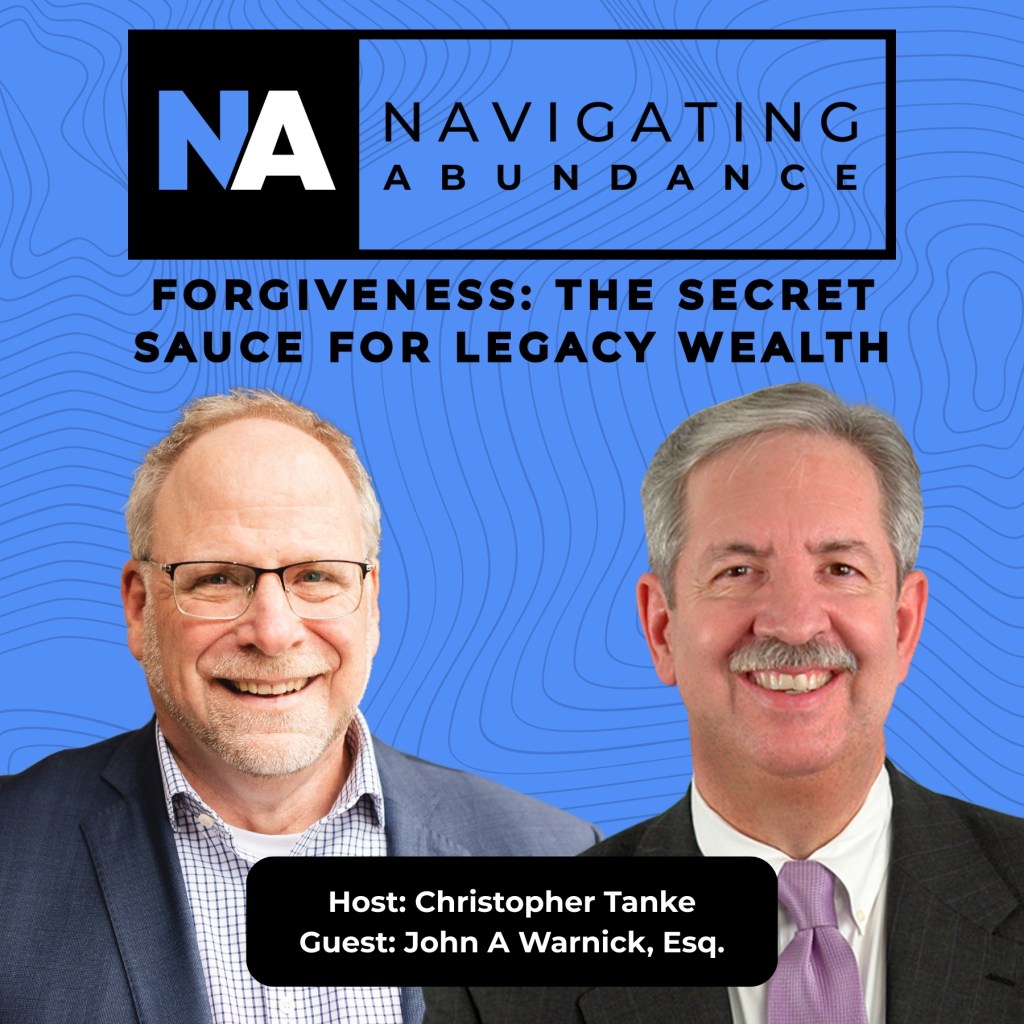
Key Takeaways
- Forgiveness is essential for building lasting relationships.
- Unresolved wounds can threaten legacy wealth.
- Self-forgiveness is a crucial aspect of the forgiveness process.
- Choosing forgiveness over resentment is a daily choice.
- Addressing past wounds requires courage and honesty.
- Forgiveness can lead to healing and emotional freedom.
- The story of the Prodigal Son illustrates the power of forgiveness.
- Joseph’s story teaches the importance of boundaries in reconciliation.
- Real-life experiences can provide hope and healing for others.
- Legacy is not just what we leave behind, but what we set in motion.
Summary
In this conversation, Chris Tanke and John A. Warnick, Esq. explore the profound impact of forgiveness on legacy wealth and family relationships. They discuss the importance of addressing past wounds, choosing forgiveness over resentment, and intentionally shaping a future filled with love and unity. Through biblical stories and personal experiences, they illustrate how forgiveness can break cycles of pain and create a lasting emotional inheritance for future generations.
Learn more about the Purposeful Planning Institute and John A. Warnick here: https://purposefulplanninginstitute.com/
Click here to view full transcript
Chris Tanke (00:00)
Wow. You really don’t want to miss this week’s episode of Navigating Abundance where I’ll be joined once again by our friend John A. Warnick, a state planning attorney, author and founder of the Purposeful Planning Institute. Our topic for discussion is a powerful one, the gift of forgiveness. So pour yourself a great cup of coffee.
Find yourself a quiet place, press play, and prepare to be encouraged.
Chris Tanke (01:16)
Welcome back to Navigating in Abundance. I’m Chris Tankey. And today we’re joined once again by John Warnock Esquire, a good friend of mine and one who is well versed in what I would consider to be legacy wealth, part of your total navigating of abundance. has spent many, years, decades in trust work, the founder of Personal Planning Institute.
⁓ is a man who really understands that the greatest riches that we have are not in our financial capital, but in our family capital. And I am just again delighted to have you with us. John, thank you so much for spending some time with us, my friend.
John “JohnA” Warnick (01:57)
Chris, it is a privilege. Thank you for inviting me.
Chris Tanke (02:00)
Absolutely right. And the last time we got together, we talked a little bit about suggestions to help you build your legacy wealth, a legacy that lasts and it didn’t take us long to realize that that will not be our last podcast. It is such a rich topic, one that is so needed that we wanted to drive home and continue to drive home. As a matter of fact,
course you’re you’re in the process of writing a book that we had also mentioned before he’s still working on it trying to get it all buttoned up entitled the gift of forgiveness and and one of the chapters that is really so powerful is the gift of forgiveness this is a touchy-feely podcast
And if you’re a high powered executive or whatever that don’t think you have time for this, I would invite you to sit down, be quiet and learn something because we’re going to bat for your legacy. We’re talking about things now that a hundred years from now will matter versus the decisions you might be making yet this afternoon. So I don’t know, you know, some of you just turned me right off. It’s okay.
But I’m speaking the truth and love to you, my friends. Forgiveness is the secret sauce of legacy wealth. If you want to pass on true riches of family wellness and family relationships and family spirit, forgiveness is just part of the deal. You put two people together, forgiveness better be in your tool belt. If you’re on your own, you don’t need it. Right? Which is so.
So I am so excited to talk about this because there are such wonderful ramifications and liberation and having a spirit of forgiveness and making progress to deal with past wrongs and realize how we recycle that into something ⁓ significant. So I will say this. John and I both have our faith traditions and we are going to be leaning on that. There will be a Bible story or two in this because as we have talked
⁓ Our faith traditions has significantly Changed our views actually have enabled us to go through with forgiveness leaning on our faith faith forgiveness is just foundational even into the end the introduction into our faith tradition, so it’s like we’re all about it and We felt that while we you know We don’t want to Prosthetize we just also want you to know
Where we are coming from and we will be sharing some of those stories with you as well because we just have to we felt so I’m really looking forward to that as well so with that, john i’m gonna just just ⁓ As we enter into this i’m going to be using What I found to be a really neat paragraph in the gift of forgiveness as our outline for today
But before I do that, should probably hand the baton over to you and say, do you want to have any introductory remarks that you’d like to share with people before we begin?
John “JohnA” Warnick (04:55)
You know, I didn’t think we were going to disagree on anything, but here right at the beginning, I am going to disagree with you, but please take this as a very mild disagreement. When you said that if there was only one, you know, we can kind of throw forgiveness out. It’s a thing that requires two or more. Truthfully, there’s a chapter in the gift of you called the gift of self-forgiveness.
Chris Tanke (05:18)
Hmm.
John “JohnA” Warnick (05:19)
Forgivement oneself is part of the whole spectrum of forgiveness and I wouldn’t want people to forget about that. But I agree with you, Chris, totally that we’re going to be focused on forgiveness as a legacy tool. And it is, truthfully, in my experience, one of the most powerful forces in the world, not just spiritually, as you’ve alluded to.
but generationally. So I see it showing up in my work with families constantly. The greatest threat to legacy isn’t taxes. It isn’t poor financial decisions. It’s unresolved wounds. And as I often say, unhealed pain becomes an emotional inheritance. So really, I’ll just wrap up by saying I think forgiveness, if you think you don’t need it, you’re not being honest with yourself.
And forgiveness really needs to begin with honesty, honesty internally and honesty, externally as well.
Chris Tanke (06:25)
That is so powerfully said, John. It really is. And again, from the voice of practical experience, it’s just fantastic. The paragraph that I was referring to, and I’m going to bring it closer to me because I’m 66 and I can’t see so well, is this that you wrote. It says, you are serious about building relationships that will last through eternities, now is the time to lay us out.
aside bitterness now is the time to do it and then I put in parentheses of course that’s the question that anybody would ask well how do you do that right because I’m hurt or somebody else is hurt or we have an estranged relationship or there’s too much pain or there’s too much water under the bridge how do you begin and then you have three different I guess steps one we must acknowledge and address past wounds
Two, have choose loving forgiveness over resentment. And three, intentionally shape a future of love, unity, and failure. And I kind of look this as the past, we have to address what happened. The present, we have to choose forgiveness over resentment. And the future, what are we going to shape by this new direction of healing? And so I think…
I think there is so much to talk about as we prepare for this. We’re like, wow, you know, how exciting, what a great topic. We just hope we have the right words for you today. But I want to start with the first one. If you’re serious about building relationships, now is the time to lay aside bitterness and it begins by acknowledging and addressing past wounds. Would you ⁓ comment on that a little bit for us?
John “JohnA” Warnick (08:07)
Well, I think it’s a very powerful opener for us. Forgiveness really is a choice, and we could say present choice. It’s a choice that we need to address now, not let any more time, because the more time that passes, the more difficulties often there are in surmounting and healing past wounds.
So I really do think that this choice that we have of choosing loving kindness, seeking forgiveness, if we’ve, and sometimes it is just a matter of doing an assessment and opening up the doors to communication because we sometimes don’t even know
how we have harmed or hurt another until we let them in honesty and candor share with us the wound that we’ve inflicted that we may have been completely oblivious to. Sometimes we know exactly what we did, but we may not know the depth of its impact. In all cases, just creating time for conversation and being willing to accept that I have had a role
may be a very significant role. Maybe I am the sole person responsible for the estrangement. Being honest with ourselves and with those that we love and want to kind of redress these wrongs with is absolutely key to being able to step out of a past of estrangement into a future of connection.
Chris Tanke (09:47)
So, you the first step then if I’m hearing you’re right is you have to address the reality of it We could pretend it doesn’t exist or we don’t have time to deal with it because it might hurt too much But in in addressing the reality that we have a situation here, maybe if you don’t know what it is I just know something’s not right That means there’s probably going to be discussion and forgiveness involved with it It’s a courageous choice to begin
to swim in that pond. we don’t always know the outcome of that, whether we’re going to be successful or not. We are out of control a lot in that. But can you encourage us on how we can look at this so that we can at least step out into the unknown of resolution and get the courage to do what’s right?
John “JohnA” Warnick (10:21)
No, they don’t.
You know, we often think that the key to reestablishing connection to building greater relational foundation, that the key to that is the individual that’s estranged, that feels wronged in some way. But the reality is we hold that key.
It really needs to start with us. And I would say that if you are willing to be courageously honest, it would start with doing a self-assessment. Before you even have this conversation, can you begin to think about all of the ways in which you may have contributed to the problem? And I would say just from a spiritual standpoint,
seek divine inspiration to be able to understand what your role in it is. Don’t presume that you’re the innocent one. We all have sinned, we’ve all wronged, we’ve all been guilty of saying things that sometimes we didn’t even hear or understand what we were saying or appreciate the impact that
it was having on another, the acts and the choices that we’ve made, we sometimes don’t appreciate how bitter and stinging those acts were to the person that they were directed towards. And sometimes we didn’t even intend that they be directed to that individual. So it really does start with this and inventorying assessment, doing that self work.
And then once you’ve done that, begin, I would say to prayerfully ask the Lord, how do I address this? How do I approach the individual? How do I kind of let them know that the door is open to a conversation?
Chris Tanke (12:36)
Yes, and so I guess one of the things that we would I would say is that if you’re going to seek significant forgiveness and or reconciliation It’s okay to realize you’re out of your league That this is something that that you might not be You might not have all the facts And and but that doesn’t mean that you shouldn’t start and you shouldn’t try and you shouldn’t make progress
Yeah, human relations are very complicated. And frequently, not only do I not understand the situation well frequently, I don’t even understand myself very well. And I need other people around me like my wife and whatnot to shape and to help me understand, you know, coming across. That’s just how it works. So but the I think the important thing is, in looking at the past here is to say, Hey, even if I don’t know exactly what it is,
There is a situation here and once I discover it confess it. What is my part in it? What is my role in it? You know coming to truth first of all, then we can come to resolution. But first we have to start to say here’s a problem and here’s what I think it is and maybe even here’s my culpability in it. But the point is I don’t want it to to ⁓ language. I want to deal with it, you know, and I think that’s important is is.
because it’s so easy just to sweep it under the rug and move on and What we’re talking about is being proactive in forgiveness for your family and your relationships And that takes courage but the but the The benefit far outweighs any initial uncomfortability, right? I mean
John “JohnA” Warnick (14:12)
Totally. think, Chris, I just add, if we don’t face the pain of yesterday, it’s going to haunt the story of tomorrow. So we just can’t let the past stay in the past. When we do that, we’re really choosing to let bitterness be our companion or the companion of the individual that we’re estranged from.
Chris Tanke (14:21)
Mm-hmm.
Mm-hmm. Very good. So essentially number two. That’s a good segue into that once we acknowledge and address past wounds That’s the first step and now it’s in front of us. We have to do something about it We have to choose loving forgiveness over resentment. That’s like a present ongoing work choose Loving forgiveness over resentment and you said before forgiveness is a choice
And it is and so could you expand on that for us a little bit?
John “JohnA” Warnick (15:08)
Well, I’m just wondering this when we get into the present, there are a couple of biblical stories that come to mind and one that I love is the story of the prodigal son. And everybody thinks about the prodigal son and how he wasted a fortune. You know, he gets his inheritance.
because he was the younger son, probably only got a third of his inheritance, but it was a sizable amount. And he wastes it and then comes to himself and realizes that the servants in his father’s home are much better off than he is. And he comes home. But what we kind of miss sometimes in that parable is the role of the father. The father…
didn’t just sit idly waiting for the sun to come. The father went up on top of the house and looked out every day and looked to see if the sun was coming. The father was constantly waiting. And I think there’s a lesson here for all of us. want to kind of speed up. We want to speed up the.
the forgiveness process. We want it to occur on our timetable. And I think the reality is we need to understand that God’s never late, but he’s rarely early. He works in hearts and not on a calendar. And we need to trust in his timing and be patient and do everything we can, but we can’t force this along. But when the opportunity arrives,
I love that point in the parable of the prodigal son. The father came down once he saw the son coming. He didn’t just saunter out. He raced, he ran and embraced the son. this, it’s such a sweet event when reconciliation occurs, when the wounds of the past are set aside and when we can, and the father,
If you read the parable closely, there are three things that the Father does to celebrate the return of the prodigal. And we need to be prepared in the present when this great fortune, this grace of healing, of the estrangement in our families, when that happens, we need to be prepared to celebrate that and not put off the celebration. There’s a lot of work that has to be done, but eventually,
in the current, in the present, as that work is completed, we should celebrate the return of the protocol.
Chris Tanke (17:54)
And make no mistake it began with the the heart that said if I ever have a chance to forgive I will and that was that that decision was made and what makes us such a beautiful story is how Hopeful how proactive the father was in looking for that return which again
In our faith traditions, we would say our Heavenly Father is looking for each one of us to do the same thing and and yeah, and and You know for all the the righteousness that he that prevails in his his judgment He is very interested in reconciliation and has gone to great lengths to accomplish that we would even say through the cross so it is It’s it takes a lot of courage to say yep
John “JohnA” Warnick (18:22)
He is.
Chris Tanke (18:46)
There’s some things that are wrong in the past here. Let’s seek to work it on it. But then again, it takes a proactive spirit and willingness to choose the right path and to look for opportunities to do that. And I think that’s fantastic. That’s fantastic.
John “JohnA” Warnick (19:04)
the beauty of this and remember the prodigal, the father probably didn’t contribute much to the problem, the estrangement. was all on the younger son, but that didn’t let the father, didn’t keep him from racing to embrace his son. And I think whatever our level of responsibility is for the estrangement, we should think about the fact that
Forgiveness today breaks the cycles of yesterday and it frees us from the prison. We are in a prison, so is the estranged family member in a prison until the grace of forgiveness and healing take place.
Chris Tanke (19:49)
Very very well said very well said so We must acknowledge and address past wounds. Let’s be honest about it. Let’s face it Now we got a problem, how do we solve that? Well, we’ve got to choose loving forgiveness Over resentment and I think I’ve heard it said before You know sins in your life Are going to either make you bitter or better?
Depending how you how you deal with that because bad things happen to good people all the time and sometimes you know, I’m the one that Doesn’t behave the way I should and bring that upon others. That’s just that’s just Unfortunately the human condition So choose loving forgiveness over resentment and then finally intentionally shape a future of love unity and faith
That takes a very spirit of a positive approach as bad things happen to good people. Again, bitterness or betterment, is how am going to handle the pains, the deep pains of the world?
this is the story of Joseph. he was the youngest of 12 brothers Had a dream God brought to him that said guess what you’re gonna be over your brothers And he decided he should share that with them
which of course they didn’t appreciate very much. So they decided in the Cliff Notes version here to take him for a walk and as his father sent him out to follow the other 11 brothers addressing the herds many miles away from home, they saw him coming and said, here’s our opportunity to get rid of the lad.
Because in a Semitic culture, a very nasty thing for the younger brother to say, I’m going to be your ruler. So just want you to be ready for that. So they basically found a cistern that was dry and threw him down in it with every intent to leave him there to die. But then here comes a caravan of merchants that were on their way to Egypt selling goods. And they made a deal with them. They said, we’ve got a neat little Jewish boy in the cistern who would really
be fantastic in Egypt. He’s smart. And, you know, he might be he might be a good servant in the household. So they they cut a deal, they paid for him, they they load him on the camel and off they went. So here’s Joseph saying, wait a minute, I thought I was supposed to over my brothers and now I’m being sold into slavery, right? So anyway, essentially, he ends up at Potiphar’s house, who’s an Egyptian. Brechtorian guard leader.
well known by Pharaoh and he does he serves him well and and Potiphar says take care of my entire estate you’re doing a great job well the problem is his wife thought he was doing a good job too and found him to be Rudy and handsome this the text says and decided that that she would like to have his way with him and continue to follow him around but there’s John there’s nothing like a woman scorned
John “JohnA” Warnick (22:22)
Yeah.
Chris Tanke (22:35)
And she was rebuffed so many times that at one point when he ran from her rather than get involved with that situation, she hung onto his cloak and then went to her husband saying, here, here’s proof he was in, you know, our house trying to have his way with me, which actually that was not true.
So then Joseph is thrown into prison innocently, again thinking, now wait a minute, where does this blessing of God come in again? I keep doing the right thing and I keep getting further and further away from what I’m told I’ll receive. It’s lovely story. Anyway, long and short of it is, ultimately he gets out of prison because of his ability to interpret dreams, which also then comes down to Pharaoh and his dreams when he understands his fame. Pharaoh is blessed by
him to the point of where he then puts him number two over Egypt over everything. And this is, by the way, 17 years of age is when he was through in the well. Now he’s 30 years old. There’s been a big delay in blessing. And so there he is, you know, still interpreting dreams for Pharaoh. ⁓ the text tells us that he had another dream that ⁓ was to let him know there was a seven-year famine coming.
That if he was smart, he would put up store of goods To prepare for that and he did that fair or appreciate that because when the famine came They were the only country in their region that had goods and so now everybody was coming to them Giving them homage giving them do giving them money Selling their properties to them so that they could survive because of this the foresight and what was going to happen Well, wouldn’t you know?
Here comes his dopey brothers because they’re starving as well. And they show up and they don’t recognize who he is because last they saw he was on a camel, heady for who knows where. They didn’t recognize him, but he sure recognized them. And it was very interesting how the he kind of toys with them for a little bit. I guess we can get into that some of the time. But in the end, his brothers
recognize who he is he he he lets them know once later who he really is and they think man this is it we’re going to be run through as we should but then he says something incredible to them and i think it’s really great for this conversation today for redemptive forgiveness he says no no no no no as for you you intended all this for evil
But God intended this for good to bring about this present purpose. What an attitude of releasing your rights, extending grace and forgiveness so that you can have a present purpose, you can have a future today. We must acknowledge and address past wounds.
choose loving forgiveness over resentment and intentionally shape a future of love unity in faith because if we if we let it god could actually intend all of this for good we could all learn something and move forward with it and with that john if you would like to share your story i would be blessed to hear it
John “JohnA” Warnick (25:50)
Before I do, I just want to say that was beautifully told. I think just a kind of an exclamation point I’d like to add to the story is Joseph didn’t just want to have a kumbaya. Let’s, you know, let’s get roast marshmallows around the fire and just have a wonderful time together. Before, when he recognized who these brothers were, he
Chris Tanke (26:06)
You
John “JohnA” Warnick (26:14)
deliberately structured a future with his family and in a sense put down the paving stones for forgiveness with some boundaries and with great wisdom. And he tested them and then when they passed the test, he embraced them. But then he didn’t just take them in, he put them out in the land of Goshen, which
Chris Tanke (26:30)
Mm-hmm.
Mm-hmm.
John “JohnA” Warnick (26:44)
There was great wisdom in that. It’s kind of, I would say the parallel for our families is that sometimes when we get reconciled, that reconciliation needs to come with some new boundaries. So there were boundaries in the Joseph story too. So let me share the story that I think ties all three of these past, present and futures together. This story, if you Googled,
Chris Tanke (27:01)
Yes.
John “JohnA” Warnick (27:11)
the Casper Star Tribune in about 1999, you would find a front page story that is this story, but I’m gonna share the rest of the story with you and your audience today, Chris. So it started out with my wife and I, our son was being treated for a deep depression and we didn’t understand the roots of the depression until we were summoned to meet with he and his psychiatrist.
And it seemed pretty ominous when the psychiatrist said, John B, do you want to tell your parents your story or should I? And my son kind of put his head down and said, you. And then the psychiatrist told us that our son had been sexually molested when he was 10 years of age by a soccer coach. And it happened when we had been out of state and had given permission for the soccer coach.
Chris Tanke (27:47)
Hmm.
John “JohnA” Warnick (28:06)
to be his chaperone and guardian on this trip to a soccer tournament. And this pattern of ⁓ molestation had occurred repeatedly over a four-year period of time. And this was the root cause of the depression our son was fighting. He was now 19, almost 20. And the psychiatrist says, and the reason that we’ve called you here is your son
Chris Tanke (28:17)
Hmm.
John “JohnA” Warnick (28:31)
either needs to report this to the police or I need to, but we cannot let this pedophile go without being turned in to the police. So we had a family council that weekend. You can’t imagine the degrees of anger and grief, emotional pain that my wife and I went through, but we gathered our family together. His sisters begged him not to because they didn’t want
⁓ the publicity of this hanging over our family. And he made a various due comment. He said, if I don’t confront him, he’s going to own me for the rest of my life. This is the only, it was 19 going on 20. If I don’t confront him, he’s going to own me for the rest of my life. So my wife, there was a problem.
Chris Tanke (29:11)
How old was your son?
that he’s going to own me
for the rest of my life. That’s that’s one of the shackles of an unforgiving spirit. Love that. Love that. Okay.
John “JohnA” Warnick (29:24)
Yeah.
It is.
my wife, there’s so many elements of grace and providence in this story. My wife had her last year of law school done in externship in the district attorney’s office in Casper, Wyoming, where we were living at that time. And she had worked with one lawyer who now had been promoted and he was the lawyer that
was in charge of all of the sexual crime prosecutions. So she called up this lawyer, Mike Schaeffer, and asked if he could meet with our son. So our son meets with him. He has people there from DCI, FBI, and they tell my son that it’s really difficult to prosecute a pedophile. They need hard evidence and they ask him if he’d be willing to do a sting operation. So they train him.
to go in and tell this pedophile that whenever he’s around young boys, he has these urges and he doesn’t know what to do about them. And the pedophile sung and gave him a DVD, burned a DVD or CD, whatever it was at that time, from an internet site that this perpetrator had created called Boys Lovers of America.
and John B walked out and the police were in a van just two doors down the street and waiting for him. so this ends up in a state and federal prosecution. The molester is in prison for 55 years of prison time. But the most powerful part of that segment of the story was our son.
appeared at the sentencing in Cheyenne in federal court and the judge asked him, you have anything that you would like to say to the defendant? And my son stood up and faced the perpetrator, the molester, and said, today is the day I take back my life. You don’t own me anymore. I now own my life, my future.
And so in a sense, that was the beginning of a healing. But the real story is it took really 10 years for this to, for us with a lot of prayer and a lot of, you know, I said earlier, we’ve got to trust in the Lord’s timing. It didn’t happen immediately. Despite a lot of fervent prayer, we didn’t wash that anger, hostility out of our hearts.
Chris Tanke (31:39)
Mm-hmm.
Hmm.
John “JohnA” Warnick (32:03)
It took a long time and my son had to go through a lot of treatment for trauma and he’s been able to surrender his anger and is able to largely cope with the harm that was done and functions very well today, which is a little bit unusual. Oftentimes the victims of sexual molestation don’t survive it that well. But I just want to share with you and every listener that
we can trust in a healer who has incredible power to heal things that seem impossible to be healed. I’ve experienced that and I know that this grace of forgiveness and healing is possible for all of us if we’ll put ourselves in a position to seek it and be patient and wait on it.
Chris Tanke (32:57)
Might I ask, has your son
Does he continue to use that experience in other people’s lives or in?
John “JohnA” Warnick (33:06)
Great question, Chris. And it ties into really maybe a capstone comment here. About eight years after this sentencing, the DCI investigator came to my son, contacted him and said, would you meet me in Denver? I’m coming to Denver. We had moved to Denver at this point. I’m coming to Denver. I have somebody I want to introduce you to. And the individual he introduced my son to
was the director of the Center for Missing and Exploited Children. And what they asked my son to do was to serve as a consultant and to basically speak once a month in different corners of the country to school security officers, school psychologists, principals around surviving sexual molestation from the male perspective. And my son,
did that for about six or seven years. That was hugely therapeutic. And he would report to us when he’d come back from a trip to Dallas or to LA, wherever he was speaking, that sometimes he spoke to audiences as large as 900, 1500 people. He would say that it wouldn’t fail that at least one, if not two, three or five people would come up to him and say, because he closed, he always closed his talk with the story that
He was the only one of 27 victims that was willing to testify against the perpetrator. And there was a log kept and the police contacted all 26 others and John B was the only one that was willing to testify against the perpetrator. Well, John B basically made the point that until you choose to take back control of your life, you’re gonna be owned by a perpetrator too. ⁓
Chris Tanke (34:30)
Huh. Huh.
John “JohnA” Warnick (34:56)
It seemed like every time he spoke, a victim would come up and say, you know, I’ve not dealt with this. Thanks to you, I’m going to deal with it. And that’s been a huge blessing to our family to see how his struggle has been enabled to help other individuals come to grips with the horror of sexual abuse.
Chris Tanke (35:06)
Hmm.
As much as you and your wife would like to address that audience John B is going to speak to their hearts. He is uniquely positioned to do that acknowledge past wounds choose forgiveness over resentment and then intentionally shape a future going forward
You know, the intention was evil.
but in faith there was a good actually that could come out of it and I don’t I don’t mean to minimize what John be dealt with. I just know that God is in the business of recycling garbage. It’s what he does and it’s painful and I wouldn’t I wouldn’t in a million were million years wish that garbage upon your son, but he has chosen.
to allow a recycling process, to even take that which is unimaginable to be able to now present it in a way that releases, that forgives. There are still consequences. He’s dealing with that, of course. But to be able to then say, OK, here’s what I’m going to be doing going forward, that is a beautiful, beautiful illustration of ⁓
of recycling grace. It really, really is. And I think for whatever, ladies and gentlemen, that you’re dealing with in your family and in your relationships, you know, it’s it’s worth addressing it. It’s worth courageously moving forward with it. And with humility and with persistency, more often than not, good things will come out of it.
And and even if not everything is resolved much of it perhaps will be but it takes courage It takes optimism. It takes looking, you know, like the prodigal’s a son’s father looking for opportunities to do it and As as as I like it heard said that the the journey of forgiveness it may take time But it is not a waste of time It is not a waste of time
John “JohnA” Warnick (37:22)
That’s beautiful.
And I think this ties into really the heart of this podcast series that you sponsor, Chris. I think I’d like everybody just to realize that legacy isn’t just what we leave behind. It’s what we set in motion.
Chris Tanke (37:42)
Mm-hmm. Well said.
John “JohnA” Warnick (37:44)
And so being able to deal with the resentments, with the hurts, and to then have a vision to, you know, have the courage to deal with them and then a vision to structure in faith, be patient, good things can come. So if your family isn’t where you want it to be and you’re worried about the emotional legacy you’re going to leave behind, I hope we’ve given you hope today that no matter how
Chris Tanke (38:08)
Hmm.
John “JohnA” Warnick (38:10)
difficult, how deep the chasm of that estrangement is, it can be forged. You can get across it.
Chris Tanke (38:18)
So powerful. Thank you, John, for your vulnerability today, for your heart, for your courage. Please let John B. know we appreciate this and your wife that we appreciate this as well. I think this is such a such a powerful, wonderful, optimistic podcast because there is darkness in this world.
But my goodness, if we can face some of this and start dealing with it.
I said to the way God’s in the recycling business. He just does that He just does that and so thank you John Wow, I don’t have words. I Appreciate our friendship so deeply Appreciate our conversations. We have a really good time doing that with each other
John “JohnA” Warnick (38:52)
I love it.
You really
do. And thank you, Chris, for telling the story of Joseph. It was beautiful.
Chris Tanke (39:09)
That’s fine and thank you for telling your family story. That’s tremendous. So So John keep working on the book. I’m ready to sell it. So ⁓ the Yeah, the gift of you and that’s still he’s still working on that to perfect it. We look forward to that in the meantime, thank you so much for your time my friend and Remember ladies and gentlemen, if you take anything from this conversation today, remember your family is worth it
John “JohnA” Warnick (39:17)
Okay.
Strategic Financial Group (39:36)
Thank you for joining us for today’s episode of Navigating Abundance. If you found this information useful or helpful in any way, let us know in the comment section below. If you’d like to see more content like this and follow our podcast, you can find us on all major podcast platforms. If you’re interested in working with today’s guests, you can find their information in the description of this podcast. If you’d like to know more about Navigating Abundance and how we may help you or find more resources related to what we do, you can find those at navigatingabundance.com.
 Navigating Abundance
Leave a comment