Key Takeaways
- Healthy boundaries are essential for thriving in family businesses.
- Conflict is a natural part of relationships and can lead to growth.
- Understanding the difference between hurt and harm is crucial.
- False guilt can hinder decision-making and personal growth.
- Support and challenge from others are necessary for navigating complex family dynamics.
- Responsibility in relationships involves knowing what is yours and what is not.
- Healthy boundaries promote good and protect against the bad.
- Communication is key in resolving conflicts within family businesses.
- Emotional intelligence plays a significant role in managing family relationships.
- Investing in understanding boundaries can lead to healthier family dynamics.
Summary
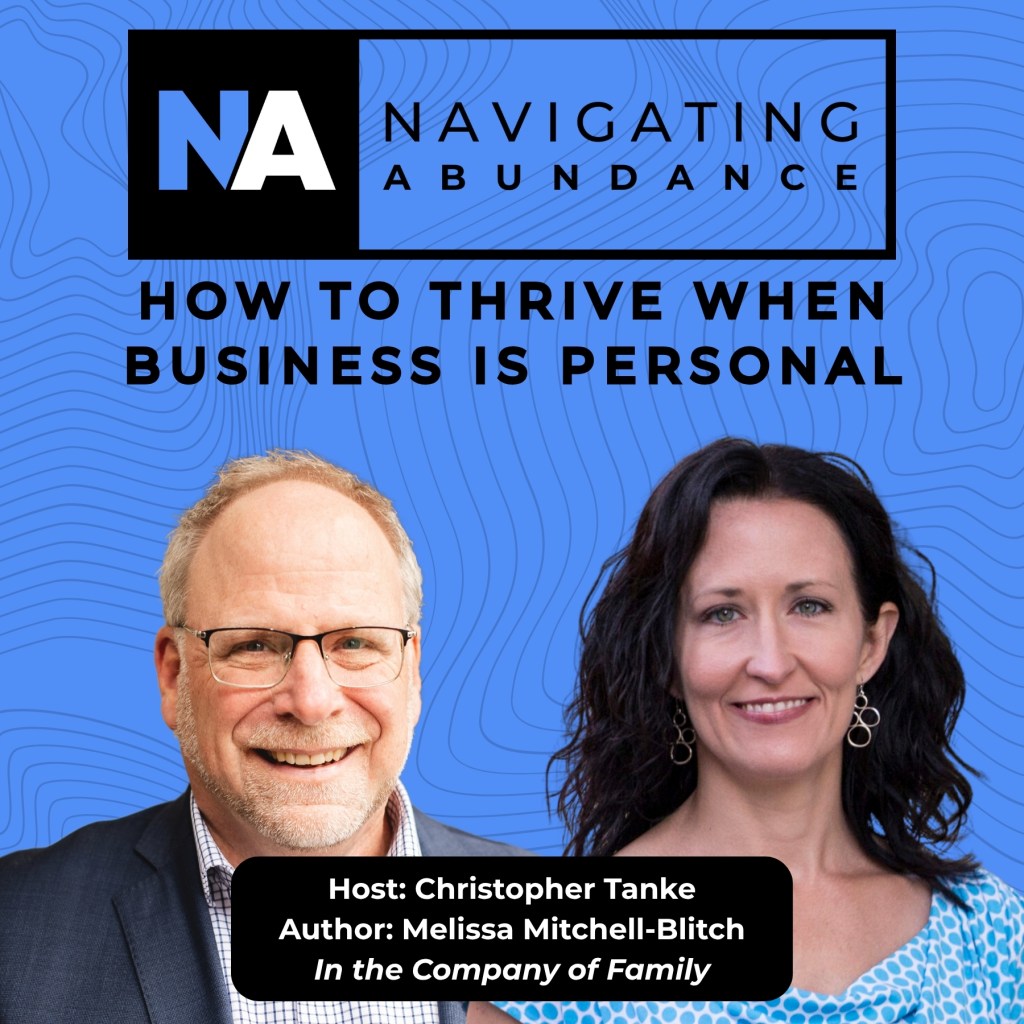
In this conversation, Chris Tanke and Melissa Mitchell-Blitch discuss the complexities of family businesses and the importance of establishing healthy boundaries. Melissa is the author of In the Company of Family: How to Thrive When Business Is Personal. In this episode of Navigating Abundance, they explore how relationships within family businesses can be both rewarding and challenging, emphasizing the need for clear communication and understanding of responsibilities. The discussion highlights the significance of navigating differences, the impact of guilt, and the necessity of support systems in fostering healthy family dynamics. Melissa shares insights from her book, ‘In the Company of Family,’ providing practical advice for family business owners to thrive personally and professionally.
Learn more about Melissa’s work: https://melissamitchellblitch.com/
Click here to view full transcript
Chris Tanke
Welcome back to Navigating Abundance. I’m Chris Tanke. Today we have as a very special guest of the firm, a friend of a firm, Melissa Mitchell-Blitch. She is the author of a book that I’ve got to tell you has really impacted my daughter and myself. And we wanted to bring her on to share with you. And it’s entitled, In the Company of Family, How to Thrive When Business is Personal.
On our Navigating Abundance website, you would go to our list of highly curated resources and you’ll find this book there. Of course you can get it on Amazon and other places, but I want to tell you. We made a commitment to read this book once a year. That’s how much we really appreciated it and we’ve only read it through a couple of times already. So it’s not the kind of thing that you it’s a one and done. It’s something that you can. ⁓
Really, I would say come back to again and again and refresh and say, how are we going to apply this? It’s that good. What do you think, Melissa? How’s that for a rounding endorsement?
Melissa Mitchell-Blitch (02:15)
That is high praise, Chris. It really means a lot to hear that the content I wrote connects with people and is something they feel like they can benefit from time and time again. Fantastic.
Chris Tanke (02:26)
Yep, for sure.
For sure. So thank you. We’re, we’re looking forward to just having our conversation today, having a little wisdom maybe shared back and forth and some of your experiences and, yeah, it’s a if you’re a family business owner, this is for you. Actually, quite frankly, the book would cascade into somebody who doesn’t even have a family at all, and just work with other people. I mean, it’s it’s human relationships.
And it’s going to talk about this really scary word that’s used on occasion called a boundary and how that is really actually liberating once you understand where the fences really are and we’ll discuss that too. But first, Melissa, this is a, you know, this is a big thing. You know, I was an author, co-author of a book one time and it was exciting, but exhausting. What caused you to be inspired to even approach this?
this effort of in the company of family.
Melissa Mitchell-Blitch (03:23)
Well, it’s funny, at least to me, you know, when people would hear about the work that I do with families and business, just appreciating how challenging that is, I would hear time and time again, ⁓ you should write a book about you have stories to tell. And I would think there are stories to tell and I have no desire to write a book. And this went on for years, probably about seven or eight years into my work. And then just one day I just felt, I felt compelled to write a book.
on boundaries for families and business because a family business is actually a boundary violation. Family in its nature is very different than business. so families who enterprise together, who have these endeavors together, they are doing something that is at its core, unique and challenging. And while there are wonderful books out there on boundaries, I felt led to.
create one specifically tailored to families and business to show them exactly in their complex situation how the principles of boundaries can actually bring some simplicity to the complexity that they’re in and help them to thrive as individuals, as families, and as a business. Three very important priorities that can oftentimes compete.
Chris Tanke (04:40)
Mm-hmm. Yes, and again, it’s a big commitment. It’s a big labor of love to say, okay, I’m going to try to codify all this and I’m going to go through the editing process and it’s really, it’s excruciating writing. It just is. to put it, you know, to finally get it done and to send it out there into the world, the exciting thing is that outlives you.
And it, you will touch people if anybody is writing or if you’re preaching a sermon or anything you’re doing, you have no idea who it’s going to touch. That’s the exciting part of going to publish. And, ⁓ and again, I think this is something that, ⁓ that really would benefit any family business. If you’re listening to us, you have a family business. I’m telling you right now. You need to read the book, buy the book, your family’s worth it. Spend some money, spend some time, think about it. This is great stuff. Can I read the preface?
Is everybody here?
Melissa Mitchell-Blitch (05:31)
You can,
I just want to say, know, my hope when I was writing the book was exactly what you said, that it would go out there and have a life of its own, touching people that I would never meet and never even hear about. And just today someone posted on LinkedIn about the new audio version of the book. She said, this book has already changed my life. And I was like, yes. So it’s fun when you get to hear about it. Yes, yes.
Chris Tanke (05:51)
Yay. Yeah, hey, isn’t that neat? Isn’t that humbling?
Yeah. Yeah, that’s really
great. You know, navigating abundance, this podcast, in particular, all the podcasts we’re doing, you know, all the things that we bring, you know, we realize that we’ll be helping more people than we’ll ever meet or hear from. And that’s the neat, that’s the serendipitous nature of this, right? You know, in today’s economic economy, you throw it out there and somebody from Singapore is going to get a lot out of this and we’ll never hear about it. Isn’t that neat? I love that. It’s really, really cool.
Melissa Mitchell-Blitch (06:20)
So cool.
Chris Tanke (06:23)
I gotta read this preface here because I think it sets up the book beautifully. Some of the problems and some of the solutions just by reading the first couple paragraphs here. folks hang with me. we go. Relationships. We want them. We need them. They bring us joy and give meaning to our lives. They also bring us pain. Conflict is a natural part of relationships.
What makes relationships both meaningful and difficult? Differences. At times differences complement and enhance. Other times there are rough edges that irritate us and grade our patience. Opposites attract until they repel. Doing business as a family multiplies the roles you share. You’re a family, co-worker, co-owner. You spend more time together than if you were only family members or business relations.
More roles, more time together creates more opportunities to differ on opinions and priorities and values. The multiplication of differences creates more conflict and compounds the complexity of your relationships, both personally and professionally. When you work with family, business is personal. Learning to navigate differences well is crucial. And as I said, my daughter is a co-partner.
with me in our primary firm strategic financial group and now in navigating abundance as we build it out. And it’s real interesting, you know, throughout the book. And I remember on time to time, I’d look at Stephanie and say, hey, this is what you’re doing. This is what you’re saying. And we talked about, you know, about boundaries in particular. So it’s it’s it’s really great. So I I think that paragraph really sets things up very, very well.
to understand and we all know it intuitively we are experiencing it personally that that that business is personal so let’s talk about I guess I can share kind of my misconceptions of boundaries or things that I might think initially but why don’t you share with us some of the maybe some of the resistance that that
that you’ve experienced when when people start talking about establishing or understanding boundaries because that is the foundation of dealing with differences in a positive way. Right. So why can you fill in the blanks here for us?
Melissa Mitchell-Blitch (08:48)
Yeah, boundaries, and you touched on this earlier, can be a very emotionally charged word. And after the book took on its life and went out there in the world, I realized as I was getting feedback, I did not address that well, that to some people, until they understand what boundaries really are about, they sound like a four-letter word.
Chris Tanke (09:09)
Mm-hmm.
Melissa Mitchell-Blitch (09:09)
You know,
people may think that they are against me. I spoke to a family office executive yesterday and I said, I’m curious, when I say the word boundaries, what comes to mind for you? And he said, limits, limits of what we are willing to tolerate. And I said, yes, that is a part of boundaries. It is not all boundaries, but that’s kind of the vibe that people until they know that there’s a broader sense tend to tend to carry. You know, boundaries are about all about you and not about me. It’s against our relationship. It’s
Chris Tanke (09:18)
Mm-hmm. Right.
Melissa Mitchell-Blitch (09:37)
telling me what I can’t do. And boundaries are not. They can be used that way. And that is not by design and by intention. Or that’s not only what’s possible. Boundaries simply put is anything that differentiates one thing from another. So they exist whether we do them by intention and design or whether it’s accidental. If I say, yes, Chris, I will have dinner with you tomorrow night,
I have said, I put a boundary, that is a boundary to everything else that I could do with that hour and a half of my time. If I say yes to my husband, I’m gonna be married to you until death does this part that says no to everyone else that we might’ve shared our life with. every choice that we make, we’re saying yes to something, no to endless number of things, and by doing that, we’re differentiating one thing from another.
Chris Tanke (10:06)
Mm-hmm.
Melissa Mitchell-Blitch (10:27)
And so boundaries just exist and they are meant to promote the good and protect against the bad, both within like my individual life, in your individual life and in our relationship. It’s meant to promote the good and protect against the bad in all areas and roles that are important to us. Sometimes those compete, sometimes they clash. And that’s what the principles of boundaries can help do. They don’t tell you what to do.
but they give you some framework to consider decisions and competing priorities to weigh. When there’s not one right answer, when there’s not one perfect answer, when there might not even be any good answers, how do I weigh this decision of what I say yes to and what I say no to? The highest good that I can protect and want to protect in this and protecting against the bad as much as I can.
Chris Tanke (11:19)
Mm-hmm. You know, we’ve got Two wonderful grandsons that are right in the thick of it. They’re three and six and They just spent three full days with Papa and GG last weekend. It was wonderful and it was stressful all at the same time and Just love those little critters had the best time really really did but you know Boundaries are really important You know, yeah
there are certain things that they just can’t be doing. Other things that they can be doing. And actually, the older we get, the more we understand that boundaries are in our lives, really not to so much as a club or to club us, boundaries are there or the fences are there so that we can understand where our best life is gonna be lived. A speed limit is a boundary. It’s a good thing that it’s there.
And you violate it you might have a bad experience So so, know initially someone might hear the word it’s not a lovely word and I don’t think I mean you Melissa you might love the word but most for us to be like boundary. yeah. Yeah That means my wings are gonna be clipped. That’s me. No, it’s gonna be criticized That means somebody’s gonna throw it up my face and therefore not listen to me because this is my boundaries and all this other kind of stuff When it really doesn’t have to be that way at all
And and if you think about it everybody boundaries if you didn’t have them in your life Even with a husband and wife there are certain things. I know that my wife doesn’t appreciate There’s other things she knows. I don’t appreciate There are certain things in my life that that i’m to put aside So that i’m going to make sure that that I can be a blessing to my wife. That’s a boundary as well So, you know, let’s let’s not give such a don’t don’t throw the you know
the possibilities out with the word everybody if you’re listening to this boundaries could actually be a very good friend to you.
Melissa Mitchell-Blitch (13:12)
They can. In the book, Chris, I’m reminded I share the example of like two transparent circles that are overlapping. You know, one is yellow, that’s you. One is blue, that’s me. And to form a relationship, those overlap and there’s some green there. The principles and practices of Healthy Boundaries help us to honor those three things. That you are unique, you individual. I am a unique individual.
different and separate than you and the relationship that we create, the practice of healthy boundaries will actually promote all of those things. So as you were saying earlier, when we were talking about the preface, differences are normal. So conflict is normal. How do we do that? Well, when our differences clash, how can we do that? Well, navigate that how we show up, how we treat each other in the midst of that, the practice of healthy boundaries can help.
illuminate options for doing that well.
Chris Tanke (14:05)
Exactly right. Now this is touchy-feely work. This is getting into people’s opinions. And there are motions behind this that will potentially surface, et cetera. But the alternative, of course, is just to go through the motions to say, here are the rules. This is how we do things. This is how we’ve always done things, et cetera, and not really understand
people feel about it the whys behind their responses to these things and that is that is You talk about An emotionally charged situation that’s much worse if two decades down the road We we have now this sever in relationships within our business because we didn’t address boundaries and feelings or continue to address boundaries and feelings, you know 20 years earlier, so
This is something that that I think we all understand is something to be concerned about or to think about. We might not be gifted to make a lot of progress with it, but, you know, make no mistake, the downside of not understanding everybody’s boundaries and how this might work together and continue to discuss this, the downside of that is is really bad. And
I think that’s how a lot of family businesses get in trouble. can you, can you, inspire us? And the book does this. And I think before we got on everybody today, I told Melissa, the cool thing about this book is it’s, it’s so positive and so redemptive in, in saying, here’s how you guys can handle differences rather than saying, we have differences. And you know, we’ve argued about it and what, no, no, no, here’s how we’re going to handle this. Here’s how we’re going to start retooling the way that we’re approaching each other.
We don’t have to be clones of one another, but we certainly have to get along with each other. And how are we going to do that with mutual understanding? So that’s a lot to say. Melissa, coming back to this. So your family enterprise, you you’re, you’re, you’ve dipped your, your, your toe into this conversation. So could you ⁓ bring us some benefits of.
Establishing boundaries or understanding how to apply boundaries and conversations ongoing conversations about boundaries in your business enterprise for the person That’s a numbers person that doesn’t know how they feel about these feelings, you know Can you rescue them from that thought?
Melissa Mitchell-Blitch (16:19)
actually, I’d love to answer your question a little bit differently. When you were building up to your question, a recent family was coming to mind where they had what I describe as a relationship earthquake. It was sudden, it was deep, and things weren’t going to be the same going forward.
And they reached out to me and I could imagine they probably were anticipating, know, Melissa, could you come in and just help us to have these conversations better? And as I met one on one with each of the, it was a dad and three daughters, as I met with each of them individually, I heard how they were thinking about the conflict. And I didn’t think that just simply getting them in the room with a facilitator was going to be enough, that they needed some ways of thinking differently.
being able to take some different perspectives on the conflict, on their relationships, to be able to get to a place where they could heal and reconcile and start to move through this. And I remember the dad saying, what’s my responsibility here? He had made a choice and all three of his daughters were very hurt, one especially. What’s my responsibility here? I know she’s hurt, but don’t have a right to be happy. Or should I feel…
stood up, felt guilty for wanting to be happy. And he touched on in his question three, I call them the big three principles of boundaries. They help us to deal with responsibility, hurt and guilt. You know, to have healthy relationships, one of the keys to healthy relationships, whether it’s a family, whether it’s business, you know, partners or all the above is to know what am I responsible for and what am I not responsible for?
recognizing as well. And I’ll just do this overview and then you can come back and we’ll go more in depth however you want to go. But to have a good relationship, each of us needs to know what we are responsible for and what we’re not responsible for. To be responsible for what is ours and then continue to be responsive to each other in that relationship without taking responsibility for what is not ours. It’s an important distinction. And then as we make those choices, just
Chris Tanke (18:25)
Mm-hmm. Mm-hmm.
Melissa Mitchell-Blitch (18:30)
You know, even at our best, we’ll hurt each other. It’s the natural outcome sometimes of those differences that we’ve been coming back to often in our conversation today. You know, I will hurt you sometimes in the choices that I make, not because I want to, but it’s just natural. I am different from you. I may make choices different than you, and you may not be happy with that. But there’s a spectrum of pain. know, hurt is normal and can actually lead to growth. I did some
Strength training in my legs today. Tomorrow I may be little bit sore because those muscles have been strained through that effort and it’s a part of the growth and the maintenance process. Sometimes pain comes, but there’s a level of pain that’s hurt on one end of the spectrum and then builds in intensity and duration and impact, although yet to harm. And sometimes we in the South, grandmothers and mothers will often say, be nice, don’t hurt anyone’s feelings.
You know, pretty is as pretty does, but hurt can be a natural, constructive part of a relationship. If we can’t disagree well, do we really have a relationship if we can only be in relationship when we agree? So hurt is a natural part of relationship. How do we do it? Well, again, so I’m responsive. You know that I care that this decision hurts you, but I’m not taking responsibility for your hurt. I can support you moving through it.
But I realized that I have a responsibility to weigh my choices and make them to the best of my ability. And then like, if I know ⁓ I’ve made a choice and you feel hurt, whether I anticipated it or not, like this dad may feel guilty. Should I feel guilty for wanting to be happy? Well, is being happy a crime? No, you know, but there’s variations of guilt. Sometimes we can feel guilty, feel bad.
because we’ve done something wrong. And that’s true guilt that’s meant to prompt us to do something about it. Maybe learn from it, maybe say, I’m sorry, but true guilt is a bad feeling that is meant to prompt us to take corrective action. And then when we do that, can, that true guilt can lift. But sometimes we feel guilty when we haven’t done anything wrong. And that’s like a straight jacket. I call it false guilt. And the only way to get out from under it is to realize what it is.
Chris Tanke (20:26)
Mm-hmm.
All right.
Mm-hmm.
Melissa Mitchell-Blitch (20:49)
faults, figure out what the true emotions are. Maybe it’s sadness. Maybe I’m sorry that this decision hurts you. Sorry that I can’t be two places at once, you know, but to address the real emotions that are there. So dealing with responsibility, know, boundaries can sound like a four letter word, but they help us. The practices of healthy boundaries help us deal with responsibility in relationship, getting clear on that, dealing with the fact that we will hurt each other in relationships, how to navigate that.
and what to do with those feelings, feelings bad when we don’t get what we want or we’ve disappointed someone else. Three really important dynamics in relationships.
Chris Tanke (21:30)
So these principles of boundaries, these three, I actually want to go back to them and dig down a little deeper in all three of them. But again, I would say the consequences of not trying to continue to sow understanding and resolution to these things is just going to make everything worse. And if you’re a human being and you’re in relationship with another human being,
This is this you can’t opt out of these kind of thoughts and conversations. It’s impossible. And that’s what marriage is a lot about learning how to navigate boundaries with one another. And sometimes we don’t enter in, especially when we’re we’re younger in our marriages with as much intelligence and care as as you know, hopefully now my wife would say I’m a little better at that. But but.
you know there is there is great
healing is not quite the word I’m looking for. There’s a great sense of satisfaction and humility. When you look back and say, Look how far we’ve come. And I got I’ve been married for like 44 years. Look how far we’ve come, what we’ve been through what we’ve worked through what how closer we are now, because there were some bumps along the way and sparks flew as we are inevitably dealing with boundaries. So it is
It is something that you can’t ladies gentlemen get out of you. You can’t like opt out of that conversation. You might not like the word, but ⁓ it will find you and you’re going to have to deal with it. So let’s deal with it positively. Let’s figure out how to use it. The offenses, so to speak of differences positively. So Melissa, I’m going to, don’t mean to put you on the spot, but if you could help us understand a little bit more, I’m going to look at these three responsible, responsible for.
versus responsible to that’s a very important boundary principle foundational one for you and could you describe that a little more detail maybe give us an example and why that’s so critical i have to understand the difference between what i’m responsible for and what i’m responsible to
Melissa Mitchell-Blitch (23:27)
This to me is the foundation of Healthy Boundaries is being able to understand responsibility. It is maybe the longest chapter in the book, the meatiest chapter in the book, probably the hardest chapter to write in the book. So I’m going to give just a sound bite on this and just say there’s so much more to unpack here. But I love how words can benefit us. If you look at the word responsibility, it’s a combination of response.
ability. So what is my responsibility? Only my ways that I can respond. I can respond by words, actions, thoughts, feelings. So my words, actions, thoughts, feelings are my responsibility. They are my ability to respond. I can’t control your thoughts, feelings, behaviors, emotions. So I’m not responsible for them.
But you and I are in relationship and I want that relationship to remain healthy so I need to be responsive to you. Even though I can’t control, I can influence and I care what your thoughts and your feelings and your behaviors are. And just realizing like this dad who said like, what’s my responsibility here? You do I have to feel guilty for wanting to be happy?
Chris Tanke (24:35)
Mm-hmm.
Melissa Mitchell-Blitch (24:39)
taking personal responsibility for your emotions, I cannot fix them. I can support them, I can’t control them, I can be responsive to your emotions, but I can’t take responsibility for them. ⁓ Please.
Chris Tanke (24:51)
I’m gonna jump in real quick. What an amazing
liberating thing that boundary brings to you, my dear friends, right? I am not responsible for what’s going on, but I am responsible for how I am to respond. And in my response, which I am responsible for, as I, you know,
try to bring healing or direction or resolution or response to something that I consider to be really nuts or bad or harmful, my response can actually bring healing into that situation versus explosion or name calling or whatever, heightening it and just word vomiting up to somebody, wait a minute, I’m responsible for a controlled, measured
truthful, honest response. And that might make all the difference in the world, not only to my message to get through, but for that individual understanding that I really do care about him. I mean, that’s big time stuff. It really is. And that’s a boundary.
Melissa Mitchell-Blitch (25:56)
In the book, there are lots of case examples, names and details have been changed, but these are real people. the family represented in the Responsible 2 versus Responsible 4 chapter is a family where they had a family business member who was in active addiction, had a substance abuse problem. She blew up at a company event and they were trying to figure out how to respond to that.
You know, they loved her. She did great work. She needed a job. She wanted a job. Were they responsible for continuing to employ her as a family member in this family business? What were their responsibilities there? And that teeter totter of responsibility, you know, like if they just let this go or, whatever, they could they could very easily over respond. And how might that not protect the family business?
they could over respond and how might that allow this family member to continue to abuse substances and to under respond herself because she wasn’t taking personal responsibility for her choices. There really is only a certain amount of responsibility to go around and being able to understand what is my responsibility and fulfilling it. And then where does that end the limit of it and leaving your responsibility to two really can again help us to have
better relationships.
Chris Tanke (27:20)
I’m thinking again, I’m putting on my old pastoral hat now because I was in ministry for 20 years. I’m thinking that the New Testament admonition that we are to speak the truth in love. Two boundaries right there. You know, it’s my job. It’s my responsibility to tell you the truth, not to let you continue to trip along into lies because that could be harmful. I mean, you know, and this is, this is, that’s a dangerous thing to say, especially in today’s world. People don’t want to do that.
But it’s my responsibility. If I see you going over the cliff, I’m supposed to reach out and help you. That takes truth. And yet, I don’t do it with a club. I don’t do it sanctimoniously. I do it in love. have to do it that way as well. And that speaks, I think, to my responsibility when I have a conflict. Can I do it?
in love?
Am I am I being
In saying what I think needs to be said, and understanding that it might not be received, am I doing it to the best of my ability in a way that is going to be understood and at least if there’s disagreement, I know my heart was right. Which comes back to the second one here, hurt versus harm. mean, these things just cascade one after another, Responsible for versus responsible to and the next is
Making sure that ⁓ you know, we understand the difference between hurt and harm in our interactions. Could you could you extrapolate on that for us?
Melissa Mitchell-Blitch (28:50)
You can, and I’ll go back to the example in the book, Betsy is the name used in the book. You know, the family spoke the truth in love to Betsy. This behavior is unacceptable, you know, and it still hurt her. It still hurt her. She lost her work that she enjoyed. She lost her work that she was good at doing. You know, she went in a tailspin and it damaged, you know, there it’s strange.
their relationships for a time, but they, was the truth. This behavior cannot continue. It is not good for you. It is not good for us, the clients, the firm. They spoke the truth in love and it still hurt. And you’re not able to work here until you know, that substance abuse is dealt with. It hurt and they felt guilty. They felt bad, but did they do anything wrong? Was it true guilt? They spoke the truth. They did it in love.
Chris Tanke (29:26)
Hmm.
Melissa Mitchell-Blitch (29:44)
Did it still hurt? Yes. So they didn’t do anything wrong by saying, Betsy, this behavior is not acceptable. We want to do all that we can to help you get help. But until you do, you cannot work here. It’s just not going to work. So it wasn’t true guilt. It was false guilt. And so they unpacked that and dealt with the sadness, the grief, the fear, you know, that they felt about setting this very firm boundary with Betsy.
Chris Tanke (29:56)
Mm-hmm. Mm-hmm.
Melissa Mitchell-Blitch (30:13)
And yeah, so these three interplay together and I think so many challenges that families face, families and business face. If you consider what is my responsibility? What is each of ours? You know, responsibility here. How can I take full responsibility with that and be responsive to you without doing your part, pretending like I can do your part for you? What to do with pain, disappointment? You know, that could naturally happen.
when their differences and decisions and then how to deal with the emotional impact of that, which can be real. Yeah, and sometimes, you know, I’ll just add this, you sometimes we could do the right thing and we don’t get the outcome that we want. Betsy pulled back from the family. actually took a couple of years before, you know, things started to repair. And so you can make
Chris Tanke (30:48)
Mm-hmm.
And I’m sorry.
Melissa Mitchell-Blitch (31:08)
Just because you don’t get the outcome you want doesn’t mean you did the wrong thing. Sometimes these things just take time.
Chris Tanke (31:16)
Right. Yeah. Yeah. And yeah, you’re right. And there is not always the reaction that you’re hoping for. But, you know, truth is truth. And eventually, eventually, I think it needs to least be understood or the truthful position needs to be understood. But boy, you can just blow that up something awful.
If you’re right in thinking and wrong in your delivery, you just can and that that that’s not then you really messed it up. And of course, we’ve all done that before too. So this is this is courageous work. You know, families are messy. I don’t always like the way I behave myself. And I’m just with myself. I mean, know, so this is this is this is messy stuff. But again, it’s so worth it, even if you’re a pragmatist.
Melissa Mitchell-Blitch (31:56)
I’m with you in that.
Chris Tanke (32:05)
And you don’t like necessarily Have a heart beating toward Repairing relationships even from a pragmatist position if you don’t solve these things You’d have much more trouble down the road and that’s a really cynical way of looking at it. I guess I’m talking to the To the maybe the the type-a entrepreneur Charge ahead businessperson, you know Souls be damned. I’m just gonna do what I want to do
If you don’t if you have a family business or if you yeah, I just or if you have a wife or a husband Wow These things you really need to start. It’s just really smart to start dealing with this and to understand that really the rest of my life I’m going to be Understanding that everything in my life is personal has consequences and and and whoever I care about in my sphere of influence
Is going to be different from me in a lot of ways That’s how it works. Okay, if that’s true That means that we have to roll up our sleeves and figure out how we’re going to make one plus one equal five How are we going to be better together even though we have differences and I think that’s where a lot of boundaries Come in mind. Can you give us can you give us some examples if it’s possible here of false guilt?
Right? I imagine their legion and how they might get in the way of what we need to be doing. Can you think of any anonymously?
Melissa Mitchell-Blitch (33:24)
Yeah, well, this
example is the example with Betsy was the substance abuse problem is an example of false guilt. The family said, Betsy, you know, this behavior cannot continue. cannot continue to work in this firm until the substance abuse is dealt with. They felt and they fired her. They felt guilty. They felt bad and they hadn’t done anything wrong. They actually made a very important
stance for her good. They allowed her to reap the negative natural consequences of her choices, hoping that they would be a great teacher to her to say, I need to do something about the substance abuse problem. They did it for her good, but she was disappointed and hurt. She was out of a job that she enjoyed, income that she needed, you know, and so they hadn’t done anything wrong, but they still felt bad. That was the false guilt. They hadn’t done anything wrong. They were actually fighting for her good by saying,
This behavior is detrimental to you and all that you care about. So we’re going to let you experience the natural consequence of that. They feel guilty, but they hadn’t done anything wrong. And that was false.
Chris Tanke (34:26)
Yeah, yeah
for sure. Okay, and and I think everybody hearing that can understand that Now can I ask this so and we have people listening today that are right there they understand they’re feeling false guilt How do they overcome it? To to either say the deed was done and somebody’s been fired already. Let’s say for their own good and that was two years ago and they’re still feeling guilty about it or
The firing has to come, but they can’t seem to do it because of this false guilt. And they know it is. How do you move ahead in that if it’s a family member?
Melissa Mitchell-Blitch (35:03)
Guilt is a funny thing. Sometimes guilt can actually be a more comfortable emotion. I’d rather feel guilty about that because then I can be hard on myself. You know, like let’s say I’m a family member of Betsy’s, I can feel hard on myself for saying you can’t continue to work here. I feel it’s more comfortable to stay in false guilt and be hard on myself than to face the real emotion that’s under, that’s masquerading as guilt, which is sadness and fear.
I am sad for the condition that my family member is in. I am sad that she won’t speak to me anymore. I am scared to death that she’s going to get behind the wheel of a car again and hurt herself or hurt somebody else. Those were the real emotions. Some of the real emotions that the family members were feeling, that they, you know, sometimes it’s easier to feel guilty, to feel bad about yourself than to admit how sad and hurt and afraid you are.
Chris Tanke (35:43)
Mm-hmm.
Melissa Mitchell-Blitch (36:00)
So getting in touch with identifying what those emotions are that you’re really feeling and dealing with those emotions is how to get out from under the false guilt.
Chris Tanke (36:06)
Okay.
And I can’t help but think I’m coming back to navigating abundance. One of our foundational principles is navigating abundance as a team sport. That it’s very difficult to succeed, if not impossible to succeed on your own on the great quest of total family wealth, your ledger wealth, logistic wealth and your legacy wealth. So coming back to this and you’re, you’re facing a situation that takes courage.
that takes understanding, which you might be a little too light on both, actually. But you really want to make some progress. You need people to support you to make some of these decisions and to move ahead with some of these difficult things. Yeah, you know, was it Hillary Clinton that got in trouble for with some sections of of political belief when she says it takes a village?
I will tell you the application of it takes a village is absolutely true. when you want your family business to thrive because of the personality parts of it, does take a bit. need support. You really do. I mean, even if you’re just listening to this and you tripped across this and you were just minding your own business today, everybody. And all of a sudden you’re saying, wow. my. Well, this was part of the village that came to you right there.
And I think that’s that’s what we need. how do you how does somebody? Wow, I mean, this is this is personal. It’s private. It’s painful. Maybe I have confided in some people before and it actually backfired because it got back to the person that I wanted to help. I mean, we all have experiences of human beings behaving badly. How do I find support? Quality support?
so that I can maybe have the courage, the understanding, the wisdom to move ahead. Because on my own, it’s sometimes difficult unless I have people in my corner. That’s a big question, I know. But could you give us just some things that come top of mind?
Melissa Mitchell-Blitch (38:05)
Yeah, we need support in order to thrive. We also need challenge. Someone who could say, who can call us on something, who can invite us to think about something differently, who can challenge us to take responsibility that is ours. We need support and challenge. And sometimes we need ⁓ objectivity as well. You know, maybe you go to a family member, you go to a friend, you know, who…
Chris Tanke (38:14)
Mm-hmm.
Melissa Mitchell-Blitch (38:33)
you know, it might not be their skill set to help you in the way that you’re most needed, or maybe they’re just not able to take that objective because they’re personally involved in that family system or, you know, that social system. So we need support, we need challenge, and we need objectivity. And sometimes we can get that in the personal relationships and or the professional relationships that we have. And sometimes different circumstances bring in different need.
Chris Tanke (38:35)
Mm-hmm.
Melissa Mitchell-Blitch (39:00)
a need for a different person to serve in that role.
Chris Tanke (39:04)
In the end, life is all a risk. And one of the risks are for you to be vulnerable with somebody else that might be able to give you that objective opinion or support or whatever. But if you’re feeling overwhelmed, I would suggest maybe the first thing that you need to think about is, I I all alone in this? And if if you are, then that might be one of the reasons why you do feel overwhelmed.
Life is a team sport and You know just like as we have said on some of our other Podcasts, you know if you want to make progress in the gym Physically it really really helps to have a the equipment’s all there You can even read a book on it on how to lift but it really helps to have a trainer to push and to prod and to challenge and to motivate
That’s just how human beings are. So, the book is lovely in the company of family, how to thrive when business is personal. You’ve got to get a copy of this. I’m telling you, and you need to read it every year. I’m to tell you that too. if, ⁓ especially if you, for our topic today, have a family business, but, but understand that, you know, you, you can’t be, I would say, and now I’m preaching again. This is my opinion.
It’s it’s possible I suppose to do this on your own but in reality, I think you need support You need perspective need encouragement to be able to continue to nurture the family boundaries Understand you those of your children yourself your spouse and how you can meld together differences in a positive way you might have to ⁓ disagree agreeably on some things
but understand where these boundaries, especially responsibility two versus four, hurt versus harm, true guilt versus false guilt, and come to own that in your own life and then be able to apply your understanding in your relationships with the people that you really love. It’s gonna take some help probably to do that. That’s okay, you’re worth it, do it. Your family’s worth it. Go ahead, invest in that and do that.
Melissa, this is fabulous. We could go on again and again. Will you come back?
Melissa Mitchell-Blitch (41:14)
glad to. I’ll just say if I could teach the world one skill set, it would really be boundaries because well, the first person it affected was me. You know, the practice of healthy boundaries has been so life giving to me and my relationships, ask my husband. And, and then just seeing it in the lives I’ve never, I’ve never, you know, encountered someone who understands
Chris Tanke (41:14)
my goodness.
We need to have him on next time
Melissa Mitchell-Blitch (41:41)
what boundaries are about that is not really a raving fan of them. And we’re all in that school of lifelong growth. That is our opportunity. But truly, if I could only teach the world one set of skills, it would be the set of skills because it is so very life-giving to each individual, to the relationships, to the community, to the organization, the business, whatever it is, figuring out how to enjoy how our lives overlap.
to honor that we are unique and different individuals to really celebrate that and to look at ways to and develop ways to support and enhance the good, protect against the bad. I mean, who wouldn’t want that? If I’m like, all right, for 1999, you can get something that increases the good and decreases the bad. Who wouldn’t want it? And that’s really what the practice of boundaries is about, increasing the good, decreasing the bad.
Chris Tanke (42:15)
Mm-hmm.
Sure, sure.
Melissa Mitchell-Blitch (42:39)
and having a framework to think through that and identify what that looks like when it’s complex and the road ahead isn’t clear and when people that you love and care about may have some hurt feelings or you may even have some hurt feelings and not get what you want. Just having a framework to think through and look for how to do that to increase the good and decrease the bad.
Chris Tanke (43:01)
And that is skillful living, ladies and gentlemen, and it’s certainly worth pursuing. Melissa, thank you so much. If somebody wants to get a hold of you, how do they do that?
Melissa Mitchell-Blitch (43:14)
The website is my name, which is a bit of a mouthful, melissamichaelblitch.com. They can connect with me there, send an email. I would love to just love to be available to help people learn about and apply these principles and boundaries to their life.
Chris Tanke (43:30)
Yeah, that would be great. And of course, we’ll put that contact information up on the screen as well. And I’ll tell you, ladies and gentlemen, Melissa is on a mission. This is not a job. This is not something to do. This is a calling. And boy, you can really see that in her book. A lot of great examples, anonymous examples, of how you might apply this.
Some really good kind of like questions at end of each chapter for you to do some more serious consideration But yes ⁓ in the end two things it’s certainly worth doing
And you’re probably going to need some help. It’s just how it works. Any huge task in life usually involves other people to prod you on and to encourage you. So there are a lot of resources available if you to find both things. Melissa, thank you so much. ⁓ This was great. I knew it would be. And we really appreciate the time. So for Navigating Abundance, this is Chris Tanke signing off, reminding you all again. Remember.
Melissa Mitchell-Blitch (44:22)
My pleasure, Chris. Thank you for having me.
Chris Tanke (44:34)
Your family is worth it.
Strategic Financial Group (44:37)
Thank you for joining us for today’s episode of Navigating Abundance. If you found this information useful or helpful in any way, let us know in the comment section below. If you’d like to see more content like this and follow our podcast, you can find us on all major podcast platforms. If you’re interested in working with today’s guests, you can find their information in the description of this podcast. If you’d like to know more about Navigating Abundance and how we may help you or find more resources related to what we do, you can find those at navigatingabundance.com.
 Navigating Abundance
Leave a comment