Key Takeaways
- Multi-generational family enterprises are vital to economies.
- Collaboration among consultants enhances service quality.
- Emotional support is crucial in family business dynamics.
- Succession planning requires proactive communication.
- Understanding family dynamics is key to successful transitions.
- Transparency in leadership transitions builds trust.
- Creating a culture of support fosters family harmony.
- Stewardship is essential for legacy planning.
- Intentional conversations can prevent misunderstandings.
- Consultants can help navigate complex family business issues.
Summary
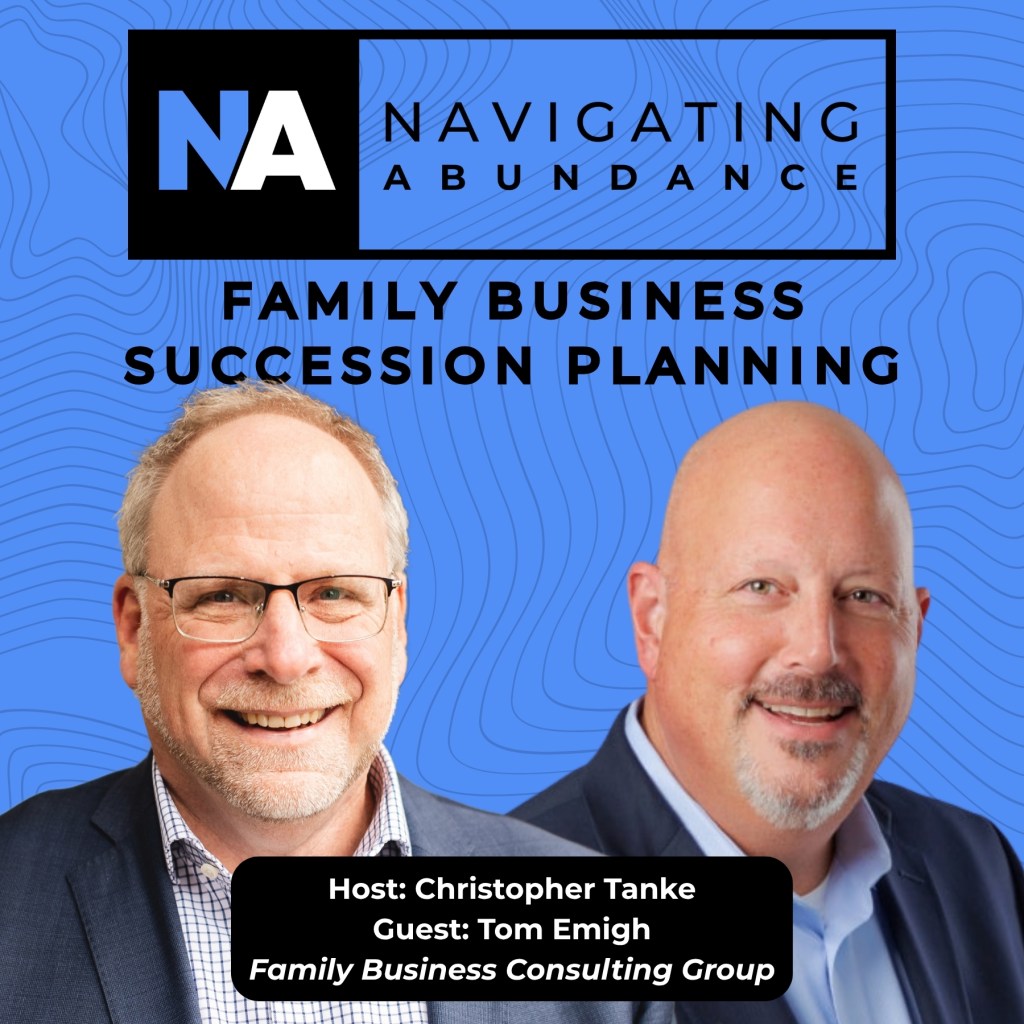
In this episode of Navigating in Abundance, Chris Tanke speaks with Tom Emigh from the Family Business Consulting Group about the unique challenges and opportunities faced by family businesses. They discuss the importance of emotional support, collaboration among consultants, and the critical role of succession planning. Tom emphasizes the need for proactive communication and transparency in leadership transitions, as well as the significance of stewardship and legacy in family businesses. The conversation highlights the value of intentional conversations and the role of consultants in navigating complex family dynamics.
To learn more about Tom and the Family Business Consulting Group: https://www.thefbcg.com/
Click to Show Full Transcript
Chris Tanke (00:00)
Our guest today is Tom Emigh a principal consultant with the Family Business Consulting Group, motivated by mission, values, and leadership. Tom believes that excellent organizations full of empowered leaders can have a positive impact in our society to help all people grow and learn. Tom’s ability to quickly establish rapport and trust with all members of business-owning families makes him a thoughtful mentor, coach, and facilitator.
Tom has extensive experience in working with family businesses, growing and developing multiple generations, and guiding succession implementation. He brings real-world leadership experience, systems thinking, and operational expertise to coaching and consulting relationships in both large and small organizations.
Chris Tanke (01:35)
Welcome back to Navigating Abundance. I’m Chris Tanke and today I’m very excited and pleased to have Tom Emigh of Family Business Consulting Group right out of West Michigan, although they’re all over the United States. Tom, welcome aboard my friend. Glad to have you.
Tom Emigh (01:51)
Lovely to be with you. Thanks, Chris.
Chris Tanke (01:54)
Sure, and so folks Tom and I had met through a family business alliance Here in West Michigan and some other mutual Contacts and we’ve had some great conversations and it didn’t take long to understand that that Tom was really working in a space that is ancillary to ours for sure and that This guy is a good amount of experience
and a great heart. He’s a really good communicator. And as being a recovering man of the cloth as I am, I imagine that we’re going to have a lot to say together. So buckle up, folks. You’re not only going to be informed, you’re going to be inspired, right? Right, Tom? Very good. Well, first of all, Tom, why don’t you describe the family business consulting group, kind of how it got going.
Tom Emigh (02:34)
That’s a high bar. Let’s see how we do together. I’ll leave you alone. Thank you.
Chris Tanke (02:45)
why you were drawn to it, and some of the work that you good folks do.
Tom Emigh (02:49)
Well, pre-family business consulting group, I, Tom, Emigh, and my wife, Tamara, were doing consulting around leadership development and culture change. We started that probably 20, 25 years ago. And you do this work in West Michigan, of course. It’s what we would call a target rich environment for family businesses. And as I found myself more and more in family businesses, I realized there are some things that were uniquely challenging and unique opportunities in the family business space.
That fit was some of my interesting experiences. So ⁓ one of our revered elders, Joe Schmider, who’s well known in the West Michigan community and beyond, at the time was an owner in the family business. And he invited me to consider joining family business consulting group. And so I did that and I’m in my sixth year there. I’m one of the partners now. And it’s been a fantastic opportunity to continue serving and learning.
you know, in the family business space. At FBCG, and I’ll probably use FBCG a lot, because it’s a lot easier to say, you know, we have a couple things that we really believe on a core level. First is, you know, your mindset or what you believe about families. We have a statement we use. It’s like, we believe that multi-generational family enterprises are precious and vitally important to the economies and social fabric of the world.
and they deserve the best care and counsel. And what I love about that, at least what resonates with me, are the words precious and care. Like, what you’re doing, business owning family, is precious. It has a huge impact, well beyond your family, even well beyond your company, your companies. And as a result, we want to provide the level of care that’s unique for you. And you, not only as a sector of family businesses,
Chris Tanke (04:18)
Mm-hmm.
Tom Emigh (04:39)
But you’re specific. So a real common name in the US is Smith. So we’ll use Smith. The Smith family industries, to use just a generic term or pseudonym, is we want the Smith family industries to do well. We want the Smith family to do well. And we want to help with that. And we have 31 years of that experience. We started 31 years ago, celebrated our 30th last year.
That’s about as long as the family business consulting profession has been around. ⁓ Two of our founders, Craig Aronoff and John Ward, met in higher education many years ago. We’re really pioneers in the space. In fact, Northwestern University in Chicago has the Kellogg School of Business, and then it is the John Ward School of Family Business. It’s just focused on family business. It’s named after…
Chris Tanke (05:11)
Mm-hmm. Mm-hmm.
Tom Emigh (05:34)
one of our founders is testimony to what he’s contributed. So I stand on some mighty broad shoulders in my work with FBCG.
Chris Tanke (05:39)
You
Right. One of the things that I found really encouraging when we were talking earlier is the, ⁓ the collaboration that you have with your fellow practitioners at FBG. you know, if, if somebody, you know, needs some opinions, some support or whatever, I mean, you can pick up the phone and, and find a collaborative conversation. I think that’s, that’s really a valuable thing to have. So you might not just get.
one coach as it were, you know, you’re going to have maybe multitudes of ones through that funneling through that one conversation. So.
Tom Emigh (06:15)
Well, that
learning together, the collaboration is a value and quarter culture. meet quarterly as a firm. So we all gather together every quarter from across the US, on site. Generally in the Chicago area, we try to find someplace not as cold in February. And we learn for a couple of days together. And we do case presentations. Always, I should probably say right at the gate, we’re
super serious about confidentiality. So if I give any anecdotes today, they’ll be anonymized. You would have no way of understanding who I’m talking about. And if one of my clients is listening, I’m probably not talking about you, although it may sound familiar. But the idea is that we get together and learn and we present cases. I could call, as you said, I’ve got 31 consultant colleagues that I can call who have this rich background and
Chris Tanke (06:53)
Ha ha.
Tom Emigh (07:07)
⁓ Craig Aronoff, one of our co-founders, is still active. I could call Craig and say, in your 30 plus years of doing this, have you seen this and what do you think? And he’s all too happy to take my call and really speak into what I’m seeing. So you don’t just work with me, but I’ve got this really deep bench all around me. It’s fantastic.
Chris Tanke (07:26)
And you really should kick the tires of the F. I trip over to the FBCG website. That’s a mouthful even saying that. But ⁓ great resources there as well that you can take advantage of. I think it’s a really good way to understand what’s available to you through this organization. Really encourage you to do it.
Tom Emigh (07:35)
it is. ⁓
We put a lot out there to help families understand. I some people want to explore before they call a consultant and we understand that. So we put a lot of what we call IP or intellectual property that we develop. And we notice other advisors using it as well. And that’s flattering. We appreciate that. And if we’re helping families, we’re
Chris Tanke (07:53)
Mm-hmm.
Yeah, that’s great. One thing for sure in the space of, you know, family businesses or as we would say, expanding it to total wealth concept, total family wealth. There is there is more need than there is capacity. ⁓ You know, so so I think I found it and we’ve talked about this before. And I’ve mentioned even on some of my podcasts that there’s a great collaboration for people, practitioners in this space.
Tom Emigh (08:20)
Hmm, well said.
Chris Tanke (08:32)
⁓ because it is a it is a just a very broad discipline and You know, it’s very frequently you have to reach out and pull somebody in But everybody’s that I have run into Just not very territorial. I just got to say that and I think that’s really neat Because this is about the family. It’s about the preferential Benefit to the family. How can we make a difference?
Tom Emigh (08:32)
Mm-hmm.
Chris Tanke (08:56)
And you know if we need to bring somebody in that’s don’t know if it’s maybe a little deeper in knowledge and experience with this if ultimately it makes for ⁓ you know a better case development that you should do it. I mean and I found that a lot I think that’s really neat and you guys have kind of built that out even within fbcg amongst yourselves, which I think is neat, too However, you’re in west michigan. You have a case
Tom Emigh (09:10)
Yes.
Chris Tanke (09:20)
And all of a sudden, you know, one of the, ⁓ the partners, is going through some serious emotional issues, life, through a big curve ball. Their decision making processes isn’t as good anymore. maybe they’re even starting to get depression or something. I mean, that you’re not, you’ve done some pastoral counseling, I’m sure in the past, but that’s not your thing. Right. So
There’s a good example. You’d be grabbing somebody or saying, hey, let’s find somebody here, right? That could assist in these types of areas.
Tom Emigh (09:50)
Oh, 100%. I really like that example because I actually have a master’s degree in counseling. I have seen clients in a previous life and I still don’t do therapy with my clients. I’m there to help them meet their goals around the family business work that we’re going to do. We talk about helping families prosper through the generations. I work with the whole system.
And it’s possible that individuals or groups of individuals within would really benefit from some counseling, maybe some specific coaching. I’m absolutely gonna call one of those professionals and have them take that relationship and focus on it while I serve the system’s goals. Just like I might call you for somebody who is really trying to understand kind of how they, you know, with this maybe a liquidity event and they’re thinking about stewardship, right? And they’re thinking about generations that they won’t ever meet.
And how do they plan that? And that’s where you and I could team well, because I do some work around psychological impacts of wealth. But you’ve got this fantastic reservoir of knowledge and experience that is very different than mine. And together we would serve the client well with the both end of what we bring.
Chris Tanke (10:48)
Right, right.
Well, let’s join forces. What do you say?
Tom Emigh (11:03)
I think your clients would be well helped and no doubt greatly amused.
Chris Tanke (11:08)
Yeah, exactly. I don’t think we’d get much done, but we’d have a very very
good time No, that that’s great that that is great. So Wonderful. Well, I Do want to talk about succession planning ⁓ At some point and I think maybe it’d be it’s such a broad topic I know that FB CG has a book on this in their resources section. I know that ⁓
Tom Emigh (11:19)
Yes.
Chris Tanke (11:28)
that you and some others have worked together and actually have a What is it two-day presentation on on this and use the book as a textbook ultimately? Could you describe what that is and in so doing I think ⁓ you know if somebody’s in Singapore They’re not gonna like come to your sessions probably but the point is that You can kind of share some a high level to logic high level I think goals and and and concerns or whatever
through succession planning, which every single business owner is going to deal with either really well or maybe not so well. So let’s talk about that.
Tom Emigh (12:04)
Well, a
great way to jump into that is very few people have been through succession planning before, because even if you’re at one point where the younger are rising or next gen and you sort of became an owner or became the leader, it looks different now that you’re maybe thinking about the future now that you’re ending perhaps the end of your career. And so the Family Business Alliance of Grand Rapids is…
a fantastic organization. Please, if you’re involved with family business in any capacity, even if you don’t work in the business, which many don’t, look them up. And if you’re not involved, please get involved. The materials, the programming they have is second to none. And they’re a membership organization of family businesses that come around to do learning and understanding together. And we’re happy to serve that. Family Business Consulting Group is a platinum sponsor of that organization.
And as part of our service to them, one of my outstanding FBCG colleagues, Rob Sly of Sly Furniture back in the day, and I do something called Succeeding at Succession. We do use a book. Let’s see if this if we have a resource, we could list this. Mine’s quite warm. It’s called Family Business Succession by Lacouvie and Pendergast, two outstanding. still working with Kelly Lacouvie is one of my colleagues.
in the firm. And we have three half-day sessions. We use a cohort model. So we put family businesses together in a group of eight to 10. And we do a deep dive into the questions around what does it take to do what we like to call succession continuity, not just succession. Succession is often about who’s going to sit in my seat while I’m gone. And we really want to emphasize that also important is how do we make moves that
that help business continuity. We want the business to persist into the future. And there are all kinds of choices that get made. And typically on the front end of that, people get overwhelmed because there’s a lot of questions. And so this three half days over about four or five months, we space it out. There’s homework, very guided, lots of good questions that you ponder on your own and come back and report back to your cohort group. And Rob and I each facilitate that and guide that.
that helps people sort of get some traction. And so by the third session, they’re starting to present sort of their initial plan of how they want to proceed. What are the big questions? What are the first things you want to do? Are we talking about transition of ownership, of leadership in one order? And often people will listen to others who are going through it and learn from that as well. So it’s really delightful not being the only sort of expert in the room.
Chris Tanke (14:40)
Mm-hmm.
Tom Emigh (14:45)
All the families in the room are experts on their experience and how they’re thinking about it. It is a rich environment and I’ve heard many stories because we’ve done this three years now and we’re signed up for a fourth, so it’s always sold out. They stay connected. So they stay connected with each other, they help each other out, they support each other.
Chris Tanke (15:01)
Right.
Yeah, you know this well, having been in pastoral ministry, but one of the most important things is to get folks involved with each other outside of Sunday morning. And so there was this small group ministry, some of you know what I’m talking about, but the concept would be that on Thursday night or Friday night or Saturday morning,
Tom Emigh (15:15)
Yes.
Chris Tanke (15:27)
Get together with a group of eight or ten people and you know work through some kind of a book or maybe you could you could Articulate your opinion on the sermon or whatever But the point is you’re getting together you’re supporting each other and and in that environment that cross-pollination of ideas and questions and support is huge a completely different dynamic than sitting in a pew and So ⁓ that’s that’s really important. So it’s really cool
Tom Emigh (15:50)
Mm-hmm.
Chris Tanke (15:54)
It’s neat that you guys understood that already and said, no, part of our process of learning is going to be breaking folks up into small groups as we go through this. And as you said, look at the lifelong relationships that developed and support that comes out of that long after you turn off the lights and the seminar is over. again, let’s say somebody’s in, I don’t know, whatever. Let’s make it Okinawa. And they’re saying, God, just can’t make it to your presentation.
Tom Emigh (15:58)
Yeah.
Chris Tanke (16:20)
So let’s talk about succession planning. If you were to have a half an hour on the phone with a guy from Okinawa or a gal from Okinawa and say, here’s the kind of stuff you have to be thinking about fundamentally, can you take us through some of the philosophy of succession planning and things you need to be thinking about or determining? I like the first one. Are you succeeding in leadership, succeeding in ownership, or both? What are you doing? Do you have others such as that?
Tom Emigh (16:51)
do, I would say to our ⁓ fictitious person in Okinawa that at the FBCG website there are oodles of resources, including more webinars, that talk about this. But specific to your question, in this Family Business Alliance, which there’s enough F’s and B’s in those you might confuse them, but FBCG is where I work and my firm, Family Business Alliance, is a membership organization in Grand Rapids that I would encourage you to
check out, but you one of the first things we ask and it kind of, it’s kind of fun to ask this when I’m with a client or with family businesses, cause they’re surprised I ask it and it’s like, why would you do this? Why would you stay in business together? Because there needs to be a passion and vision for the heavy lift it’s going to take to continue to build the business in ways that not only don’t erode, but they actually build family harmony and family harmony is something I’m really.
big on with my clients is how can we make that stronger and more durable? So why would you be engaged in some sort of business enterprise together beyond that’s what grandpa wanted, right?
Chris Tanke (17:59)
for
yeah that’s not enough you know
Tom Emigh (18:01)
It’s
going to run thin as much as respect as we have for that legacy. And, you know, I’ve got generation five, six, seven businesses and there’s so much respect for the legacy. And when you’re got a lot of debt and your sector’s turned upside down and there’s a ton of uncertainty, which seems to be sort of kind of par for the course these days, grandpa or great, great, great grandpa’s ⁓
vision is important, but it’s not the only thing. And then related to that, once they have some kind of vision for the future and why we might do this, we ask questions about how are you talking about GRPL, growth, risk, profit, and liquidity? Because if you’ve got, let’s say that we’re in the generation three of the business and you’re one of the patriarchs in the business.
If you’ve got five or six kids, all of whom are families, and your brother or sister have the same, how will that next generation four think about what they want to do with the business? Some of them may work in the business. Some of them may just be shareholders. Some of them may be neither. So how do these different groups think about growth, risk, profit, and liquidity? that, mean, just a quick example. If you’re working in the business and you’re trying to grow the business, then
You’re going to want to not give as big a dividends to your family because you’re going to reinvest the profits in the business because you’re trying to grow the business. And I’ve had several clients where it grow or die. Their sector was changing such that they had to scale up in order to be in existence in 10 years. And that became a really challenging conversation with a group of family that didn’t work in the business and just sort of had been used to receiving fairly robust dividends year after year.
Chris Tanke (19:43)
Hmm.
Tom Emigh (19:49)
So that’s another important question. then, Chris, when are you going to step out of your business and in leadership? And then as far as ownership is concerned, what’s the transition? And then that’s where we’ll call some of our friends like you or estate attorneys, because that becomes complicated and technical. People are concerned about the tax implications and all of that financial planning. But there’s also the ability to sit down and have a conversation.
about these things and really be clear with each other and talk about what you want. Sometimes in families, they haven’t been really good at that. And so we help them with that. ⁓
Chris Tanke (20:26)
All right, so verily,
verily, say unto thee, thank goodness you have a counseling experience. Because to me, as you’re talking through all of this, I’m thinking conflict resolution, conflict resolution, conflict resolution. So I mean, my goodness, for as many family members as you have that have some connection or stake in the business, you have opinions. So.
Tom Emigh (20:38)
yeah.
Bye.
You do.
Chris Tanke (20:51)
If somebody is hearing what I’m saying and saying, yes, you’re reading my mail. How do they even start to say, I’ve got to figure out how to get everybody here, at least with general agreement, generally on the same page. And again, that’s not even a fair question because this can take a couple of years and can be very complicated. But do you have any like high level advice if you’re saying, we’ve got to start making some progress in communicating here?
Do you, yeah, just get started.
Tom Emigh (21:16)
Just get started. Just get started. I mean, I say
that every week we meet with this succeeding and succession. I said, I know this is overwhelming. I know that you have questions you don’t even know how to ask yet. Just get started. Even if it’s to sit down with a couple people and don’t even worry if it’s the right group. Just sit down with some people and start saying, how do you feel about this? What are you thinking? And then as we start to get into it, I’ll start to ask questions. I’ve got a client that came out of that.
Chris Tanke (21:29)
Momentum.
Tom Emigh (21:45)
And I asked her, she’s the CEO, I said, do you have a timeline? And she said, timeline for what? I said, well, that’s a great question. When would you like to be significantly less involved in showing up at the office and doing operational work five days a week? And so then we began to explore that. And she began to come up with a timeline. I said, okay, all that stuff that’s not gonna get done because you’re not in the office, who’s gonna do that?
Do we need to start developing people? Because if you want to be out in three years, then who needs to be developed or acquired? Maybe you bring in some new talent. Maybe there’s not anyone in the family that’s quite ready for that load. And so you look outside, you look inside at non-family, but we identify, and that’s the leadership transition. And then how do we make decisions as a group of owners in transition? Who are the future owners and how have they been trained?
and develop to be thoughtful shareholders. And so those are just a couple high level questions.
Chris Tanke (22:46)
Yeah, and you know not to overstate the obvious but the The easiest thing to do is to sell it to somebody else And let them worry about that Because when when we’re involved with you know Training up leaders within our own family. We have we have history. We have background You know a prophet has no honor in his own country
It’s it there is going to be some uncomfortableness often there’s going to be Some humility often to get where you need to go and that’s just working with family and maybe ⁓ you know Confronting in love or maybe you’re the one that’s confronted as gen one that you’ve really kind of
Tom Emigh (23:11)
Mm.
Mm-hmm.
Chris Tanke (23:25)
Whatever have made a hostile environment toxic environment for any kind of shit. Everybody’s got to come to the table and say, okay. All right Let me hear what everybody else is saying. I It’s it’s such an a daunting Task and
Tom Emigh (23:40)
It is. It is.
And that’s why having support is really helpful.
Chris Tanke (23:43)
And I like what you’re saying, at least just start. mean, yeah, what is it? Here’s a book. Who wrote the book that’s ⁓ titled, ⁓ Nothing Begins Until Something Moves?
Tom Emigh (23:54)
I can’t remember but yeah.
Chris Tanke (23:55)
It’s an inertia thing, right? But you
have to get the ball rolling and then it can be directed or modified as you go. But to sit around and wring our hands saying, oh, woe is me, I can’t figure this out, let somebody else worry about that, it’s just, you’re just kicking the can down the road. It’s a problem. So it’s okay to say, right? Ay, ay, ay. This is, I don’t know how it’s gonna work out, but we’ve gotta start.
A lot of people I bet you work with are in that position.
Tom Emigh (24:24)
Well…
That’s so well said, Chris, because what we have is, you said, it’s got to be easier to sell. And I know you were just putting a straw man out there for us to think about. You know, lot of my clients, it wasn’t easy when they started something in their garage. It wasn’t easy when they had to put a second mortgage on their house in order to buy a piece of equipment. It wasn’t easy when, you know, the regulations changed or the second.
changed or private equity move in and started sniping their top talent. I these are people who have chosen many times for generations to not do the easy thing. And that’s why there are major employers in their region, if not beyond. They have a rich supplier and customer network. I there’s small thriving economies just around their business. And so I remind them of that. like, since when has easy been a major
prerequisite for you. I mean, you are here with all these families that you support through meaningful work. And many of my clients are very interested in paying above the mean and taking good care. mean, early on, I just had a conversation with a chair of the board as I’m starting with a new client. And right away, he told me about how proud they are about how they pay 100 % of the healthcare premiums. They’re aggressive in how they norm their market.
Chris Tanke (25:21)
That’s right.
Tom Emigh (25:50)
you know, how they compare the market to the jobs and the salaries they pay. And they really want to take care of their employees. And they feel like it’s not just us. It’s the and then they name the number of employees across the family. Hey, we’ve got six hundred and thirty two people that we need to take care of. And so so there is this kind of passion. And often that’s the why of why we would stay in business together. We have we have something as a family because our whole community
Chris Tanke (26:07)
Mm-hmm.
Tom Emigh (26:19)
has participated in this incredible adventure we’ve been on, this risk. And that’s why I just get stimulated to be in the room with these folks, because they’re so passionate and they’re so visionary. But yeah, it’s hard. And so I have to remind them of who they are, that they can do this for work. Yeah.
Chris Tanke (26:26)
Yeah.
I love that. I
love that. You know, you have had success here, here, here, and here. It might have taken other people down, but you persevered, stumbled around, maybe didn’t even get it right the first time, but the third time you solved the problem, it struck, it worked, and look at the fruit of that 20 years later. Here’s just another one. That’s all it is. You know, we can do this. We can do this.
Tom Emigh (26:40)
Thank
Yeah. And yet,
if someone’s listening, let me say carefully, I understand that having that difficult conversation with your son or daughter when you haven’t really talked for a couple of decades, like you talk, but you haven’t really talked about deep, meaningful things is tough. And I’ve had clients come back at me with that. know, Tom, I build a $200 million company from scratch. I was in the Marines or the Army or wherever. that was easy compared to sitting down with my daughter and figuring out what she wants to do. And yes.
Hard things are in your reach and I will help you and we broker, I mediate those conversations. I will say this about the lion’s share of my clients, this is absolutely true. Even people who are seriously sideways with each other want to do better, they just need help and they don’t know how and they need a little hope that if they try something, maybe they can get it. And that’s where I come in, is I bring some hope, I bring some techniques.
Chris Tanke (27:29)
That’s fantastic.
Tom Emigh (27:51)
I take on the strong entrepreneurial founder personality, say, hey, if you want to reach these goals, you might want to create a little more space for your family. And I work with people, right? So, yeah, that’s the joke.
Chris Tanke (28:01)
Yeah. my,
yes, I can see that. ⁓ and again, they said before, ⁓ if you’ve seen one family office, you’ve seen one family office. Well, if you’ve seen one family business, you’ve seen one family business, the dynamics, there’s some similarities, but boy, are they different. and I think that that’s the, I think that’s the fun of it. That’s the joy of it to come alongside. And if you can make a difference as a practitioner, that’s, that’s really neat.
Tom Emigh (28:14)
Yes. Yeah. Well said.
Chris Tanke (28:28)
That’s really that’s really fabulous. So All right. good
Tom Emigh (28:30)
Well, and you see
this, I gotta just brag on my clients for a second, and I’m sure you’ve seen this, but particularly in West Michigan, but not exclusively to West Michigan, our families, the people who own businesses, particularly multi-generational where they’ve developed wealth, have a deep sense of stewardship. Like what I’m doing impacts the community, and they have the sector or sectors that they’re invested in, they’re getting their next generation involved in board work, supporting these nonprofits.
And a lot of what happens in the greater West Michigan area that helps people who need some help right now is because of that kind of a vision of our business owning families. That and faith too, but that comes in as part of the value set, but that stewardship in the sense of giving back is really inspiring.
Chris Tanke (29:16)
Yeah, anybody really rises to the next level when they can understand to a great degree, this is not about me anymore. This is about I’ve been blessed. I have more than I can ever spend, let’s say, or whatever the case might be. I’ve been absolutely blessed. And now I have the opportunity to be a blessing to other people. That’s my legacy. And when you start thinking that way,
Tom Emigh (29:27)
Mmm.
Yes.
Chris Tanke (29:42)
It’s amazing what you can accomplish and the joy that it brings but You know in that blessing that you can see how you’ve been taken if you’re gen 1 or whatever how far you’ve come There is the realization that you know, the baton has to be passed and and your best self is realized when when with humility and gratitude
Tom Emigh (29:45)
Mm-hmm.
Chris Tanke (30:05)
You start working with those that are going to receive this business or buy into the business order the case might be. And getting closely involved with their lives a bit more, I would say. mean, that’s you mentioned that maybe the last couple of decades, I just had a superficial relationship with my gen two daughters that are going to inherit this, let’s say. Well, that’s great. But you you can’t stop now. You have to you have to bring it up to another level.
And you have to start. There are things that have to be discussed. And that might mean you possibly need to learn some better listening skills or whatever the case might be. But to do nothing just this really inflames the problem. So start do something. And and we’ve said before one of our beliefs here at Navigating Abundance is that
When you navigate abundance, it’s always a team sport. You can’t do it on your own. As good as books are, you can’t do it by just reading a book. You need somebody there to coach you, just like an athlete would be coached in the training room. They know how to lift weights, but they need a coach. It’s the same thing here. You need somebody to prod you. Yeah. Yep. And that is so very, important.
Tom Emigh (31:04)
Agreed.
So I believe you. Yes, it’s true.
Chris Tanke (31:14)
And again, I say that because a lot of people listening today, you know, are self starters. They’ve kind of created their, their own empire. and a lot of this is because they’re, they’re brilliant, hard workers, driven, really good wisdom, but you know, all that might not be enough. If now you are saying, I think I’m out of my league for succession planning. Cause it’s not going as well as I thought it would.
Well, if you’re as smart and brilliant and entrepreneur and driven as you are, then apply that and go get some help. That’s the smart move.
Tom Emigh (31:47)
Yes, and they no doubt have done it. I mean, at some point, the entrepreneurs doing their own books and then they realize that they continue to do their own books. They’re not going to be as effective. So they bring in someone to help and that person has deeper knowledge of the financials and they take it to the next level. And that’s true in so many areas. I agree with you. It’s a good point.
Chris Tanke (31:53)
Right, that’s right.
Yep. It so what
I’m saying it’s it’s it’s also true in the touchy feely area of relationships and succession. Don’t be afraid of that embrace it. It’s true. And, ⁓ and get somebody that’s better that can help. Alright, so coming back to the succeeding succession, are there a couple of major things that people need to be thinking about as they are about to enter into trying to discover and formalize plans to accomplish this?
Tom Emigh (32:16)
Yes.
Chris Tanke (32:33)
What, does somebody begin? my gosh, I’d like to be out of this business in five years. I think I’ve got the vision. That’s where I want to go. Now what?
Tom Emigh (32:41)
Well, I think, you one of the questions is who would you like to be involved in that conversation? And I think people who might be affected by the decision would be good to involve. so family, maybe some key executives. As you talk about your own timeline, I’m speaking from the sort of a singular leader, but at some point you want to move it to having a team of people who are thinking together about this because
Often what I see is that we think about a CEO who’s a family member thinking about transition, but you’ve got perhaps a cohort of executive and mid-level leaders that have been there as long as she has, and if she goes, they’re probably nearing the end of their career as well. And so you really need to be thinking about it through the organization. And so all of a sudden, you would be wise to talk about this broadly as we’re thinking about leadership succession as something we want to be doing.
on a regular basis. When you hire someone, you’re preparing them for a future where they’ll take on more, even as you think about your own transition. And I know I just said it’s overwhelming to just get started, and that would overwhelm you even more, but we see that a lot, is it’s not just one person at some sort of high level, but many others who are thinking about the end of their active daily involvement in the operations of the business. And then what’s the plan for ownership?
And that’s complicated. So the first thing you got to do is what is currently true. Do you have a buy-sell agreement, a shareholder agreement? Do you have partners? Are they family? Is it time to change the ownership structure? Because this is a great time to do it. Who wants to be involved in ownership in the future? How do you begin talking about that? If you have significant wealth, a lot of complexity to your business,
and your operational structure, and you haven’t really been talking about that as a family, then you’ve got a lot of things they have to understand quickly, and that’s going to be harder. So we try to get these conversations rolling on sort of an easy level, right? And here’s, sadly, what I see a lot is folks who just keep putting it off, and then there’s a tragic event, and now a family has to figure this out as they grieve. And that is…
That’s so hard. so difficult to see and we’ll come in and help with that. Absolutely. But if there could be some proactive planning and conversation and patience with that process, it’s going to go a better.
Chris Tanke (35:12)
Let’s let’s I want to pick up on that word conversation. You know, when when you throw one lever in a business, it affects many other things. You know, even just if we use the term opportunity cost, I’m going to spend a million dollars doing this. Well, that meant that I didn’t spend a million dollars doing something else. That was a decision. ⁓ I gained this, but I lost this. Was that worth it kind of thing? And so when we’re
Tom Emigh (35:22)
Mm-hmm.
Yes. Right.
Chris Tanke (35:34)
we’re thinking about our succession and we’re having conversations with key players and perhaps the circle, the first conversations with our wife or a husband, then the circle gets larger and larger and larger from there. What about broadcasting the decision? ⁓ How do you… ⁓
you know, how do you make sure that it’s a positive impact to say, guess what? I think I’m going to be retiring. And so here’s two or three things that we are working on everybody to let you know as I get ready to ride into the sunset. I imagine that’s super valuable to do, but if not done well, I think it could really bring a lot of fright into the organization.
Tom Emigh (36:15)
It could, and so here’s how people do it the most poorly, is they don’t mention it. And I’ve heard them say, I’ve got current clients I’ve sat down and said, you’re 81 or 82, I’m 82. Do you think no one else around here knows that you’re 82? I mean, and I’m not, I mean, I’m being humorous with you because it’s an ironic conversation. Of course, I’m much more gentle and respectful with the client, but I say, I think everyone is wondering.
Chris Tanke (36:30)
Right, exactly.
Tom Emigh (36:45)
And if you were to start talking about it and just reassure them about a couple of things, for example, in many of these cases, the next gen, if he’s 82, then the next gen’s probably in their late 40s and 50s. So they’re already working in. And so we’re still talking about it, but right now we’re gonna remain family owned. And the people that you see in the family already working will probably continue to have leadership roles. My son’s the CEO right now.
My daughter’s the VP of this and so on and so forth. So talk about it. And people go, ⁓ there’s a plan. Okay, good, back to work. Generally, they don’t, here’s the thing. When people see that something is not quite right, i.e. wow, this guy’s kind of past retirement age, what are they going to do? They start to fill in the gaps. I visited a client once for the first time and they wanted to show me around the shop. So we’re walking around. And the next day he called me because it was a succession job.
He was gonna have me help him with succession. The next day he called me goes, well, we gotta get rolling. I said, ⁓ I agree, but why is that? goes, because the word on the shop floor is that you’re gonna buy the business. I said, okay. So they go, here’s a guy we don’t know. He’s gonna buy the business. And I bet we’re all gonna get fired. And they were just, it just ran crazy because the owner wasn’t talking about it. I said, do you see why it’s important that you talk about it, what you’re pulling? You can say no.
Chris Tanke (37:51)
my goodness. That’s how it happens.
Tom Emigh (38:08)
That guy’s a consultant and having him help me plan a smooth transition because one of my top values is that you stay in a good job and this company carries on without.
Chris Tanke (38:19)
Yeah, I love that. love that. You know, I’m a I’m 66 years old, and I have had this conversation with my staff here that I’m going to go another 10. They are and that’s that’s a long time out, right? But they already know that as long as I have the strength, the energy and the the wherewithal to do it. The gray matter to do it, I’m going to continue.
Tom Emigh (38:20)
Well, that would be for me. Yeah.
Chris Tanke (38:43)
Because I love what I do and I love where navigating is going and strategic financial group is our main firm And I just love this. I love the clients. I love all the stuff. So I Have a lot of interest personally Outside of business and I could probably be fulfilled in doing that but I’m having too much fun with this so we I Found it was really helpful even ten years out to say here’s what I want to do guys because I know I’m looking a little long in the tooth You might be wondering so we had this conversation
I’m going another 10. And you know, when when my wife and my my daughter who is partner here, if they take me out to lunch and say, Hey, dad, your liability, dad, your love you, but your liability, I promised I’d leave. We’ve had these conversations just that frankly. And I think that’s so valuable. It’s so valuable for the rest of the team to understand. Because you’re right. Even if I’m not saying it, they’re thinking it.
Tom Emigh (39:28)
Yeah. Right.
Right.
Chris Tanke (39:38)
Right.
So for sure. I love that.
Tom Emigh (39:40)
Well, and so what you’re doing is you’re creating a rhythm of conversations, which is really what this is all about, is how do we begin to talk about what is, what we want to be the future, and how we can kind of get there together in ways that make sense, and check in along the way, because over multi-year plans, things change. So, hey, three years ago, this was my plan. Is that plan still making sense, and how are we progressing toward that plan? And sometimes things change. You know, I just read a…
an article today about how hard it is. And a lot of my families have this is, you know, very powerful people with a lot of resources don’t want to give up the keys when they turned a certain age. And it’s not, it’s not age specific, it’s skill specific. But as they get older, they don’t want to give up driving because of how that is tied to their sense of autonomy and being able to take care of themselves. And that’s a really hard conversation. It’s also hard to tell someone that they are
Chris Tanke (40:31)
Sure.
Tom Emigh (40:36)
not effective in the role. And so how can we create a place where we can have that conversation regularly, the criteria are clear. So we’re not, it’s not, we’re not trying to get rid of you because we’re tired of you, but you had set these goals, or maybe you keep the office, but you’re never in it. So let’s talk about what that looks like. It’s okay. We will always have this office for you. You may come in and sit here, but when you also wander around on the planet for and tell people to do things,
that aren’t in keeping with the recent plan we made that you don’t know about because you didn’t come to the meetings, ⁓ disrupted. So we have those conversations.
Chris Tanke (41:09)
Right. That’s right.
Yeah, and I think the important
thing is that you have that kind of communication. This goes back to relationships again, but it also goes back to intentionality. Again, just using me, we’re having these conversations now. We’ve talked about some of these scenarios that what if, you know, I fall out of my tree stand, hit my head and I’m not normal anymore as I was, as much as I was, you know, what does that look like? How do we handle this? ⁓ To have, I think that more often than not,
Tom Emigh (41:32)
Right?
Yes.
Chris Tanke (41:41)
I think that we would err by not sharing some of these concepts with folks versus, I got to keep it close to the vest because I don’t necessarily trust them with that information. I think that’s, I hope people understand that, that you have that kind of a business, that’s kind of a practice where you’re pretty aggressively communicating vision, direction, and if you’re, you know, if you’re thinking about retiring in the future,
You say, guess what? Right? Someday I’m going to be out and we’re working toward this to make the transition smooth. I just think that’s super valuable to do. So I’m glad to hear that you’re, you’re prodding people to do it.
Tom Emigh (42:15)
Yeah,
best transitions are almost non-events. Like when at a future Christmas dinner, the now aging CEO stands up and says, you know, you guys have worked with my daughter for 23 years. Nobody’s going to be shocked to say that. Starting in 26, I think she really ought to take the reins. And we’ve been working on a plan and I’ve been communicating it, but it’s effective.
So he’s just, everybody’s like, she wasn’t already the CEO? ⁓ okay. that’s cool. Right? So.
Chris Tanke (42:45)
I have that’s so that’s so funny.
That’s so funny because that happens all the time. My clients are surprised that Stephanie is not the CEO. And we’ve told clients for many years, you know, someday I’m going to retire, I guess. But the good news is you like Stephanie better than me anyway. So doesn’t really matter. And she’s fantastic. You know, so anyway, so that’s that’s that that is, think, really key. again, this will actually come back to culture.
Tom Emigh (42:50)
Yeah.
Yeah. ⁓
Chris Tanke (43:12)
and what you’ve developed at your business. But yeah.
Tom Emigh (43:12)
Yeah.
And the culture
of your family as well. I do we talk as family? And here’s the thing. I want to reassure you and anybody who might hear this. We can help you do better at that. We can help you. Because as I said, 99.9 % of my families want to do better. They just don’t know how and they need a little help. And I’ve got too many success stories to give up on you. We will get you there. Yeah.
Chris Tanke (43:41)
I love that. That is really great.
Well, let’s come in for a landing my friend. You still do owe me lunch or I owe you lunch. So we, you know, we got to get that done. But in the meantime, I’ll connect with you on that. But in the meantime, yeah, what’s the best way for somebody to contact you? We certainly put that information up with a phone number and whatnot, but how does somebody begin to kick your tires?
Tom Emigh (43:50)
Okay.
it sounds good.
Well, one of the most important questions I have interacting with clients is what do you need? What are your goals? Secondary to that is can I meet them? But the first one is what are your goals? And so I would go to our website. It’s thethe, F-B-C-G, which stands for familybusinessconsultinggroup.com. And then we’ve got a list of all of our consultants. I’ve had people call me out of the blue because they found me on that website.
I never met them before. They watched maybe a podcast or a webinar. I read a few things I wrote and said, you just seem to be a fit with us. And then other people, I’ve gotten introduced to them and I said, either because of capacity or maybe there’s something they want. You should meet my friend, my colleague Tony, who’s going to do way better at that. He’s just got so many reps or she’s just got so many reps doing that. And let’s see if she has capacity and I’ll connect you. So I have such confidence in my colleagues that whether it’s me or not,
Certainly, I would love to help, but maybe someone else in our firm is going to do a better fit kind of a job for you. And that’s the most important thing to us, is that we’re serving your needs very well because you’re precious. You are precious. What you and your family have built, we respect, we admire, we love. You’re precious. And so you’re going to feel really cared for by us. And that’s something that I bring to my practice. And so check out that website. Our contact information is on there.
And then, you know, if I can answer any questions, I’m happy to do it. We’re not a real big high pressure sales. If I’m going to work with somebody, succession continuity, they’ve got to really believe I’m the person because it’s too long a time and I’m asking you to do too many hard things for me to push my way in the front door. just not sustainable. We got to come to a place where you feel confidence that I’m the one to help you and I’m willing to wait on
Chris Tanke (45:55)
And that would start with a couple of conversations actually for sure. So I love that. I love that. And I love again, the collaboration that even FBCG has developed, but even outside with other resources you have or others, you know, we just want to help people. That’s it. And I think that most family practitioners, that is their philosophy. What goes around comes around. If I can help, that’s great.
Tom Emigh (45:59)
Absolutely. Absolutely.
Chris Tanke (46:23)
I’m not worried about winning or territory. I’m, I’m concerned more about, just being a blessing in any way that I can. And it’s not about me. It’s about, it’s about the client. I believe that, ⁓ that’s the only business model to follow. And I believe that, as a practitioner, I’m going to be a whole lot happier if I rest in that. And that’s, that’s fun. And I love that the spirit of FBCG in the same way. So.
Tom Emigh, thank you so very much. This was a delight.
Tom Emigh (46:56)
Chris, great talking with you as always, and it’s a privilege to be on your podcast. Thanks for inviting me, and thanks to your staff for helping. It’s great to have that support.
Chris Tanke (47:05)
Absolutely right. All right, so this is Chris Tanke from Navigating Abundance signing off reminding you once again, your family is worth it.
 Navigating Abundance
Leave a comment