Key Takeaways
- Donor advised funds act like a charitable checking account.
- NCF allows for flexibility in granting funds to charities.
- Givers can advise on grants without immediate pressure to distribute funds.
- Tax benefits can be maximized by donating appreciated assets.
- Private foundations and donor advised funds serve different purposes.
- NCF has expertise in handling complex gifts like real estate.
- Families can use donor advised funds to teach children about giving.
- Anonymity in giving can be preserved through donor advised funds.
- Planning ahead for charitable giving may lead to greater tax deductions.
- Engaging family in charitable discussions fosters a culture of generosity.
Summary
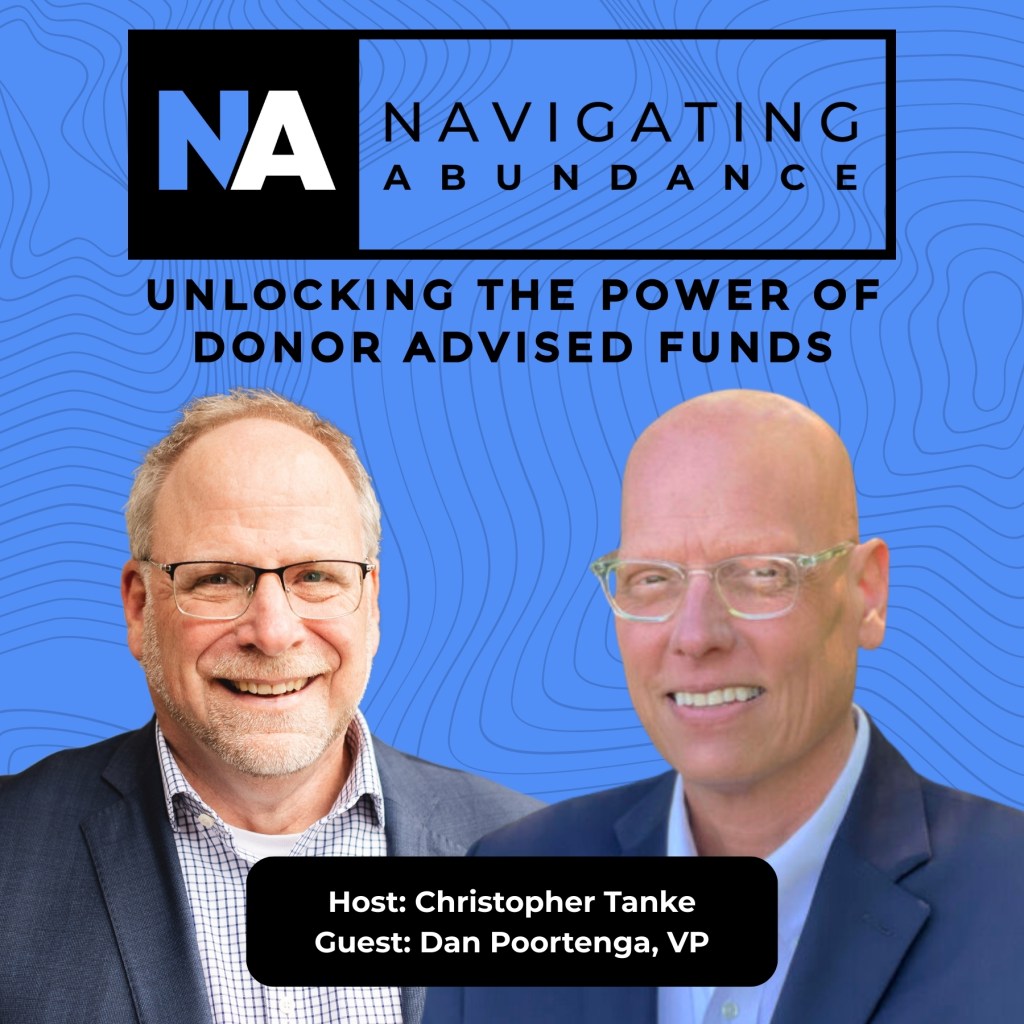
In this conversation, Chris Tanke and Dan Poortenga from the National Christian Foundation discusses the concept of donor advised funds, their benefits, and how they can be used strategically for charitable giving. The discussion covers the flexibility of donor advised funds, the comparison with private foundations, tax strategies for giving, and the importance of involving family in charitable decisions. The conversation emphasizes the significance of legacy planning and the joy of giving, encouraging listeners to explore the options available for effective philanthropy.
Learn more about National Christian Foundation: https://www.ncfgiving.com/michigan/
Click to Show Transcript
Chris Tanke (00:04.281)
Thank you so much for spending some time with us I’m very excited about this segment on donor advised funds and National Christian Foundation I just have to say I’ve appreciated our relationship going out to lunch or breakfast and talking about different things especially in regards to this vision of navigating abundance and where the the place for hilarious joyful giving comes in to a true legacy for a family of means. we continue to say it on our podcasts that one of the greatest things you possibly could do to leaving a legacy to your Gen 2, Gen 3, Gen 4 is to develop a stewardship mindset, a joy for giving and helping other people, understanding how much you’ve been blessed. So critical to developing solid leadership in you know, cascading generation. So I so appreciate you being here today, my friend. Thank you. Dan, I wondered if you could start here and just introduce NCF to folks here who may not be aware of this version of donor advice fund and and who you are and where what the scope is, etc. Can you kind of give us an infomercial on NCF?
Dan Poortenga (01:25.966)
Sure. Sure. So NCF, short for National Christian Foundation, we are, as you said, a donor advised fund platform. A donor advised fund is kind of like a charitable checking account or a charitable bucket. You can make a gift to your donor advised fund. For example, you could give a $20,000 gift to your donor advised fund in this calendar year 2025. That would be a 2025 charitable gift that you get a deduction claim a deduction for that. It’s called donor advised because you then subsequent to your gift can advise us to send grants to charities of your choice. And there’s no time limit or dollar amount necessarily and that our minimum grant out is $100. But somebody could grant the entire balance out in 2026 to one charity. They could grant it out over 20 years to…50, know, how many charities they want. So there’s a lot of flexibility there. We’re headquartered in Atlanta and we have about 30 offices around the country. I’m in our Michigan office. Last year, givers gave us $3 billion with a B and they granted out 2.6 billion to over 36,000 charities. And in our lifetime, they granted out more than $21 billion to over 90,000 charities and the givers chose those charities. We don’t choose them.
Chris Tanke (02:57.663)
Well, so, donor device fund is a 501c3. It’s it’s it’s your charity, the NCF charity, so to speak. You give to it and, but the, the very interesting thing and, and maybe even strategic thing is that, as you mentioned, you don’t need to, give out those funds or push out those funds right away. They can sit in there for a couple of years while they’re there.
Dan Poortenga (03:02.648)
Yes.
Chris Tanke (03:24.777)
There are investment choices if you want. You could have it in cash or if you want you could invest in a variety of funds or whatever. There’s a lot of variability there depending on how much risk you take and what kind of a time frame you’re looking at. Is that correct?
Dan Poortenga (03:39.182)
It is correct. internally have a number of pools that the funds can be invested in so they can get market exposure and potentially grow or not, depending on what the market does. For balances that are greater than $300,000, those fund balances can be managed by the giver’s financial advisor alongside the giver’s own investments. We have a pretty high grant out rate, one of the highest grant out rates in the country for donor advice funds. Our mission statement is mobilizing resources by inspiring biblical generosity. short-term, there’s more potential for short-term volatility in the market. so our internal investments tend to be more conservative because if the money’s already been sort of designated to be given charitably and it’s soon to be granted out, then probably no need to expose it to market loss.
But if a giver plans on maintaining a higher balance and keeping it there longer, then they’re probably better off having their own financial advisor managing those funds. Just to let you know, about half of what we get in any given year is cash. There’s lots of good reasons why people give cash. Some business owners want to tie down their profits and they don’t know until the end of the year what those profits are going to be. Instead of making all their charitable decisions on December 15, they can just make a gift to their donor advice fund, boom, they got the charitable deduction for that year and then they can make the decisions about where to grant it, where to request grants out later. I talked to somebody once who, the husband and wife were writing 25 to 40 checks to charities a month and he had a whole binder of receipts that he was keeping and had tracked down and so on. And he instead opened a donor advice fund with us, set up like 30 recurring grants, some weekly, some bi-weekly, some monthly, quarterly, whatnot.
He just receives emails that they receive emails that these checks have gone out and he ends at the end of the year, he has one receipt just for his gift to his donor advice fund. So half of what we typically get is cash, about a quarter of what we get is publicly traded stock. If somebody owns a stock like say your oppression and bought in the video five years ago and it’s gone up a lot. If you were to sell say $10,000 in video stock that you basically have a $2,000 basis and let’s say you would pay capital gains tax on that sale.
If you give that same stock to your donor advice fund, we turn around and sell it and we don’t pay any tax on it. So the full current market value of that stock goes into your donor, the proceeds go into your donor advice fund. So part of what you’re granting out to your favorite charities is money that you would have otherwise paid in taxes on that. And you also are getting a deduction for the current fair market value of that. your deduction actually includes your tax liability that was baked into that.
Chris Tanke (06:30.939)
Yeah, that’s a lovely thing. So it doesn’t even show up on your tax return. So if you’re, if you give a sizable account amount and you can’t itemize it all away, or if, if you’re really not itemizing at all, you have a very simple life and then you’re just doing a standard deduction in either case, the excess, if it’s a sizable amount, you’re not getting any credit for it. Well, how about if you just send it and it doesn’t even right at that point.
Dan Poortenga (06:59.886)
If you do own these appreciated assets, you’re better off giving those, although a lot of people don’t realize that you can give those. There’s a saying at NCF, friends don’t let friends give cash.
Chris Tanke (07:16.507)
Say that one more time and slowly.
Dan Poortenga (07:19.906)
Friends don’t let friends give cash. And that’s not entirely true because there’s a lot of good reasons to give cash. But if you do have publicly traded stock that you’ve owned for more than a year, it’s in a taxable account, you can give that and then you can just give your cash to your broker for them to reinvest in the stock market instead of giving your after-tax cash as gifts. Another big category of gifts we receive as much as 25 % a year is interest in businesses and real estate before a sale.
Chris Tanke (07:21.73)
That’s good.
Dan Poortenga (07:49.792)
NCF has some uniqueness in our pretty deep bench strength in Atlanta of gift planning attorneys, due diligence attorneys, tax CPAs, even former IRS agents. And we’ve taken in a lot of gifts that are interesting businesses in real estate before a sale, more than $6 billion of those kinds of gifts.
Chris Tanke (08:09.605)
Okay now I want to in the second half of this I want to dig into that a bit more because I think that is really revolutionary to some people the way they might be thinking. Can I ask could you juxtapose have you seen a lot of movement from people that had started a foundation and said ay ay ay the compliance is crazy. Let’s just do a donor advice fund. Have you seen some movement that direction.
Dan Poortenga (08:14.935)
Okay.
Dan Poortenga (08:31.278)
Yeah, there’s lots of that and there’s lots of good reasons for that. An analogy we like to use is suppose you have a garage and in that garage you have a sports car, a Jeep and an SUV. Which is the bad vehicle? Well, they’re not bad. None of them are bad. They all have different purposes. So if you’re going to go booning in the mountains, you’re probably going to take the Jeep. And if you’re going to go on a cross-country ski trip, the SUV is an obvious choice. The three types of entities like that we generally…that are available is one is a private foundation, one is a donor advice fund, and one is something that’s used less often called a supporting organization. So a private foundation can be a great thing because you can hire your daughter or your son to work for your private foundation. However, you cannot hire them to work for your donor advice fund. If you give a business interest gift or a real estate interest gift to your donor advice fund, you get a fair market value deduction. If you give that same gift to your private foundation, you get a basis deduction. That’s a huge difference. If you give a gift like that, a non-cash gift like that to your donor advice fund, you could deduct up to 30 % of your adjusted gross income in the year of the gift, and there’s a five-year carryover. If you give that same gift to your private foundation, you get a 20%, not a 30 % deduction with a five-year carryover. So it depends on how you’re using it.
We work with lots of families who have a private foundation. They also have a donor advice fund and they may also have a supporting organization. A supporting organization is a little bit of a hybrid. You can actually operate a quote unquote for-profit business within a charitable shell. So the profits that are generated aren’t profits you can withdraw and put in your pocket, but they are adding to that charitable dollars available within that thing. So it’s not uncommon to see entrepreneurs who are, you know, that’s in their blood, they sell their business, they still want to be entrepreneurial, they can actually create kind of an entrepreneurial organization within a charitable shell and that’s called a supporting organization. That’s typically dealing with a higher dollar amount, it may be like $10, $15 million plus kind of a thing. another interesting thing about, and you may have been getting at this, a private foundation is public and public charity like a DAF is private.
Ironically, so if you make if you have a private foundation, you have to file form 990, which is immediately published the Internet. Everybody sees what your charitable giving is into whom you’re who are you who you’re making grants to. If you have a donor advice fund, not only is are the grantees not made public, but you can actually make your grant anonymous. So even though the grantee was the charity receiving the grant doesn’t know who it came from.
Chris Tanke (11:23.131)
Well, that’s that’s great. And I want to jump on that one just a little bit. In the simplest sense, if you have just mom and pop open up a donor advice fund, my own personal experience with this is that, you know, I, I went to a seminary that I was blessed to have somebody pay my tuition. Now, of course, when I went through there was only like $600 a year. But anyway, they paid the tuition in nonetheless and books and all sorts of stuff. And that just really impacted us. for 15, 16 years, I was in ministry, I was never able to kind of like recycle that gift. Well, a few years back, we were blessed to where we could give a pretty sizable gift, something we never thought we’d be able to do. And we wrote a check to the seminary. And that was great. But what I didn’t anticipate and didn’t expect was now I’m on the mailing list. on the radar. I’m being invited to the cruises. I’m being invited to the, you know, the regional donor dinners and all this kind of stuff. And I’m, I don’t, I’m the kind of guy, I don’t want the right hand to know what the left hand is doing when it comes to giving. I want to be anonymous. I don’t want any credit at all because I, know, I really felt that wasn’t my money to begin with.
So the neat thing about the donors bias fund is you can make a contribution. and not give it out in that year. When you do give it out, it can be anonymous and you don’t, you’re not invited to the dinners. Now I find that really, really satisfying. But the other neat thing is, is let’s say that you had a liquidity event or something and you really need some serious tax write off now this year, but you don’t want to give all the money away to say to a church or a charity because then you want to, don’t want to be on their radar screen.
Well, however you want to work this with your CPA and Tax attorneys you can get credit for that in the year you give it but you don’t give it away You can then over the next four or five years Tell the donor advice fund whether it’s the National Christian Foundation or Schwab or whoever has one To give it out, you know incrementally that could be helpful as well because sometimes say a church and they’re having a capital fund drive and you want to give a quarter million dollars. If they’re trying to raise, you know, say a half a million, you might not want a quarter of a million to be to show up in the newsletter. Hey, somebody gave a quarter of a million because that might not really be most advantageous to get other people involved and excited about participating because there’s daddy war bucks out there in the weeds. Right. So that’s I love that about donor advised funds. It’s it’s great tax strategy and the simplest of forms.
There’s a lot of flexibility and anonymity. Really, really, that’s what gets us going. But of course there are advanced tax strategies when you’re talking with more serious dollars with businesses and whatnot that we can discuss too as well. And you started to allude that. Now you say it’s in Atlanta that the National Christian Foundation has a…?
Dan Poortenga (14:41.102)
Our headquarters are in Atlanta, yes.
Chris Tanke (14:42.731)
Okay, and there you have advanced planning staff there that you can.
Dan Poortenga (14:48.066)
Yeah, we have people who have a lot of experience in taking what we call complex gifts or non-cash gifts. So besides publicly traded stock, which is pretty easy, even a lot of charities can take publicly traded stock. we take in a lot of business and real estate interest gifts. So somebody, let’s say a business owner, is planning on selling their business and they’re planning on tithing with after-tax proceeds. They may instead give us an interest in that business before the sale.
So we actually are a shareholder, charitable shareholder. And let’s say they gave us 10 % of their business. We do an analysis of whether there’s a gift efficiency there. So we compare what if the family sold the business, paid the taxes, and then made a charitable gift versus gifting an interest in the business before the sale, and then go into the sale with the charity owning part of the shares, charity being NCF.
And then what are the implications out there? Typically, if the gift economics are compelling, then it’s because the family is getting a bigger tax deduction because it’s a pre-sale gift that they’re making and that there’s more dollars for charity than there would have been otherwise because of how NCF is taxed. So for example, when somebody gives us an interest in their business ahead of time, and then we go into the sale situation, the 90 % of the shares that the business owner owns, they’re going to be a LLC tax is a partnership or however they’re structured. The 10 % of the shares that NCF owns are going to be taxed as a public share. So there’s a operative. It really isn’t changing anything. We’re not involved in running the business. We’re not managing the sale or anything like that. At any given time, NCF may have ownership in a thousand, upwards of a thousand assets across the United States.
And but it’s a way to amplify your giving just by kind of doing it in an order that’s less familiar. And a lot of people aren’t aware of that. And it’s a really great opportunity, even if they decide not to do it, to at least investigate it. Real estate is even a better gift, typically when a business owner sells, like say a medical office building or whatever they may have.
They’re going to pay capital gains tax on the appreciation, and then they’ll pay ordinary income tax on the recaptured depreciation. I’m sorry, they can pay capital gains tax on appreciation if I didn’t say that, and they’re going to pay ordinary income tax on the recaptured depreciation. And NCF often doesn’t pay either of those taxes. So it can be a really great gift. I’ve got some good examples of some gifts like that that we’ve received.
Chris Tanke (17:30.677)
Yeah, do. Would you share one or two of those with us?
Dan Poortenga (17:32.75)
Sure, a few years ago there was a family that there was a Christian school capital campaign and they, the family owned lots of real estate and they said to the school, hey we have this 50 year old industrial building it’s worth about 3.2 million dollars you can have it. There was no debt, a really low basis and the school kind of balked because you know there’s environmental concerns and things like that and they said well we don’t want that new building we don’t even know what to do with it, just sell it and write us a check.
Chris Tanke (17:54.295)
Mm-hmm.
Dan Poortenga (18:01.454)
And that family was referred to us. if they had sold it, they probably would have paid $800,000 in taxes and then had $2.4 million to give to the school and gotten a $2.4 million tax deduction. They were referred to us. They gave the building to us. And they got it appraised for $3.2 million. And that was their deduction. We did have to have a phase one done before they gave it to us.
And they identified some contamination and so then that requires phase two and there was some a little bit of remediation that probably came to you know the low twenty thousand dollar range and the giver pays for that but that and then the whole scheme of things it’s not a big deal and we’re pretty accustomed to dealing with those kinds of hoops that we have to jump through.
Chris Tanke (18:45.911)
Mm-mm.
Chris Tanke (18:49.482)
That’s a lot of horsepower to be able to figure that out.
Dan Poortenga (18:52.258)
Yeah, so the school, the givers got a much bigger tax deduction, which they didn’t come to use, and the school got a much bigger check than they and the school probably doesn’t even realize that any of that stuff happened. I can give you another example where, okay.
Chris Tanke (19:06.518)
Well, hang on just a second, just to pat you guys in the back. So basically, you came up with a greater solution, but that involved some headache for you all. I mean, stage one, stage two.
Dan Poortenga (19:18.542)
Well, not headache, knowing how to navigate those things. Yeah, they could have given that building directly to the school. Some charities could have the capability, because it was the whole building to one charity. People give us, just by the way, people give us a fractional interest, so they might give us 20 % of that building or 50 % of that building or whatever.
Chris Tanke (19:23.915)
Yes. Okay. Thank you, Atlanta or whoever.
Dan Poortenga (19:44.782)
There’s another example where someone, family, wealthy family who had owned a four and a half million dollar apartment complex, had owned it for a long time and wanted to be charitable with it, but they had identified maybe eight charities that they wanted to bless from this apartment complex. If they had sold it again, they probably would have paid maybe $1.2 million in taxes and then got a $3.3 million tax deduction. They instead gave the complex to us. They got a four and a half million dollar tax deduction, they had then come to use up. It sold very quickly. In that case, we would probably ask the giver, you have a commercial realtor that you would recommend? And if they don’t, there’s plenty of them around that can’t be somebody who just got their residential real estate license, their nephew or something like that. It has to be somebody who’s qualified to represent that. But it sold very quickly. even in that case, those givers had a donor advice fund at another platform. And they let us know.
Chris Tanke (20:31.751)
Yeah, right.
Dan Poortenga (20:41.986)
They didn’t trust that platform to do the sale, but that as soon as the proceeds hit their NCF giving fund, they would be granting the whole balance out to their other platform and that’s fine. So we have a lot of experience managing those kinds of business interest gift and real estate interest gifts before a sale. It has to be before a sale. Once there’s a binding agreement to sell, it’s too late.
Chris Tanke (21:06.933)
Yeah, so there you go. Not all donor advised funds are created equal. Isn’t that interesting? They said, can you help us with this? But ultimately we’re going to be sending it over here, but we don’t trust them. They don’t have the sophistication. They don’t have the network you guys have. And I think that’s fascinating story actually.
Dan Poortenga (21:25.038)
Yeah, and we are different from other donor advice funds or what’s called an affinity fund. We’re a Christian organization. So about half of what we do is transactional, know, facilitating gifts of cash and publicly traded securities and non-cash gifts to donor advice funds to help facilitate charitable giving. But half of what we do is more transformational, really trying to guide people on their journey of generosity. And so we have tools on that camp as well.
Chris Tanke (21:52.799)
Right and and the website is a great place to kick the tires National Christian Foundation West Michigan and of course that’ll take you to the national as well to learn more about some of the nuances of this but let’s coming back to that thought I had never really considered this before somebody says look I’ve got a major liquidity event coming up they could sit down with you and you could what if with them on the different possibilities that are available do you see that a lot
Dan Poortenga (22:21.462)
You know what we see most often is people have the liquidity event and have no idea that they could have gotten a bigger deduction and given more and it’s too late. it really anybody who’s planning selling an appreciated asset in the future and don’t wait until you know you have a letter of intent and you’re closing in on a sale and then try to see if a gift is possible. It’s something you want to do ahead of time to investigate that and just see if it makes sense.
Chris Tanke (22:26.309)
Ouch.
Dan Poortenga (22:46.88)
Even if you decide not to do it, I think most people would rather have known what their options were and have decided not to do something rather than have been ignorant of an opportunity that was right there.
Chris Tanke (22:57.011)
Yeah, that’s what happens when we assume right. And again, this is very, this is very much like, and our clients understand this that gee whiz, if you have a highly appreciated non qualified asset, and you’re you’re on your deathbed, please resist the temptation to give it to your children so you can see a big smile on their face. Because you’re going to miss the step up basis if you do that. It’s the same thing.
Dan Poortenga (23:17.87)
That is a lot of people own real estate, income producing real estate that they purchased long ago because they wanted to diversify their portfolio. And now it doesn’t mix. They don’t really wish they didn’t have it anymore, but they are just going to hang on to it so their kids can get a step up in basis. Well, that could be a fuel for their charitable giving. There’s an opportunity to give that away and have it fund 10 years of charitable giving.
Chris Tanke (23:33.876)
Mm-hmm.
Dan Poortenga (23:47.064)
Couple years, everything they’re granting out to their favorite charities is money that they would have paid in taxes if they had sold it. So it’s a good way to get those kinds of appreciated assets off your balance sheet instead of just waiting around until you can pass them on to your kids.
Chris Tanke (24:00.372)
Yeah, wow, that’s great. I wondered if, and this is really putting you on the spot. You know, we are starting a new tradition this Christmas season. We’ve got some grandkids here and we have a donor advice fund and we want to get them involved with determining where we’re going to send some money during the Christmas season and try to do that every year as a family tradition.
Have you, can anything come to mind where you’ve seen families use their donor advice fund in some kind of a creative fashion or different fashion that people might not have thought of?
Dan Poortenga (24:41.358)
Yeah, and this wouldn’t be, I don’t know, you necessarily have to have a donor advisement to do this, but I know families who are on the Thanksgiving dinner table will tell their kids that they’re going to be giving them some dollar amount, a thousand, 10,000, whatever it is each to, Thanksgiving and Christmas for among their, you know, for the kids or their kids and their spouse or whatever to discuss, you know, what kind of charities they think they would like to support and what amounts for that.
And then at the Christmas dinner table, go around and discuss the choices that they made and why that may be an opportunity. Like I think there was a study where they looked at the G1 generation and what they expected, the degree to which they expected their kids’ charitable motivations to align with the parents. And I think the parents assume like 80 % of the time they thought the kids were exactly aligned with their giving choices and I think it’s more like 10%. And so it’s a good opportunity for the parents to understand that the kids may have different, they’ve been exposed to different things. There’s God’s slaves, different passions on their heart and to understand that, you know, and that also gives the kids an opportunity to sort of, they may not necessarily, depending on their phase of life, have that many resources to do that, but if the parents are providing some money. not for the to go in the kids’ but it’s a good opportunity to sort of have those conversations and see where they begin to sort of inculcate those kinds of values in their kids.
Chris Tanke (26:17.252)
And I think it’s a good opportunity for the parents in this illustration to understand not only do their children maybe have different interests or whatever, but you’ve got to be okay with those interests to a degree too, right? Because, you know, that’s one of the dangers of having this family meeting say, we’re going to give money this year. Well, you could, you could have kids that one wants to give to the NRA and the other wants to give to PETA and then you’ve got a problem, right? So
So this requires some family communication, which is a good thing too.
Dan Poortenga (26:52.418)
Yeah, and many families, it’s not uncommon for them to, they’re going to include charitable giving in their testamentary plans. And so it’s a good way to let the kids be, have the kids be aware that this is an important thing for the parents. so if, for example, a family that has three kids and they sort of divide their estate into fourths, know, the fourth is a charitable child, the kids already understand that their parents are charitable, that’s important to them. It’s part of their worldview that they believe that it all belongs to God anyway, and that way you don’t have unpleasant kind of, you those conversations and the rationale behind them are already kind of well established by the time there’s, you know, the parents pass.
Chris Tanke (27:35.164)
And that’s so important that the terminology of well established because the time to talk about this stuff is now because you’re not only setting things up for, you know, to avoiding disappointment, but you’re also again, inculcating a spirit of, of legacy that this is how we think this is, we can talk about the history of how we got to where we were. We started the business. It was in our garage and now look where we are and we’re stewards of it and have these kinds of conversations are just so critical to the next gen being good stewards and having that money be a blessing and not a curse to them once they’re driving the whole thing. So very, very important that you cannot overstate the value of that kind of these kind of legacy conversations.
Dan Poortenga (28:23.874)
Yeah, NCF really that we do, we have something called a SAT7. It’s a Saturday 7, an email that comes out on Saturday mornings. it’s really, it’s not uncommon for the subject matter to be stories about people who have successfully navigated those issues with their kids and are really happy that they had the tools and the impetus and so on and the resources to do that. We have another kind of a sister organization called Generous Giving.
And it really, it also even further kind of takes people on things called these journeys of generosity, where they really take a deep dive and those are things they can do with their adult children. And it just kind of brings the family together that way over their hearts forgiving.
Chris Tanke (29:13.714)
Those are some great tools folks. You need to take advantage of that National Christian Foundation Check out what they’ve got available Well coming in for a landing Dan any other words of wisdom you want to? Give us other than you can never out give God anything else
Dan Poortenga (29:31.694)
You know, there’s a lot of people kind of wait to do their charitable giving until, you know, it’s a bequest in their will. And one of our founders is a guy named Ron Blue, who also founded an organization called Kingdom Advisors. But he has a pithy, kind of a pithy little statement, which is, do you’re giving where you’re living so you’re knowing where it’s going. So, now. Give abundantly.
Chris Tanke (29:52.187)
Ha ha ha ha ha.
Chris Tanke (29:56.913)
That’s great. what was it? Cash is a terrible thing to waste. What was that other one? Friends don’t let friends give cash. Boy.
Dan Poortenga (30:02.318)
Friends don’t let friends give cash.
It’s not entirely true, but if you do have alternatives to cash that are more efficient, then why not do that?
Chris Tanke (30:12.578)
Absolutely right and you could work with your advisor whether they’re your financial advisor tax advisor Legal advisor have conversations and to be strategic about your giving because in the end You know your charities can spend the money more wisely and I would say more morally than the federal government can So that’s your opportunity Do it legally do it intelligently, but do it proactively
Make sure you got enough lead time because we’ve all heard stories of shoulda, coulda, woulda, and that’s not so good. All right. Well, great. So, so Dan, we’re going to have, in the show notes and whatnot, we’ll have your contact information, even if somebody’s listening to this and they’re in Fresno. if they want, said, I like that guy, the way he communicates, they can call you, right. And you can coach them and then maybe get them to a local chapter. Is that, can that work?
Dan Poortenga (31:06.497)
Yep, Yep, I can be a triage for sure.
Chris Tanke (31:09.329)
Alright, so the National Christian Foundation is not territorial ladies and gentlemen, so everybody wins With giving there you go. Yeah, and you know, which ones are good and which was they’re not so good,
Dan Poortenga (31:15.672)
We have three offices in California, so yeah.
Dan Poortenga (31:23.384)
Well, I’d refer to the one by Fresno. We do have local events, like a generosity ecosystem. So if they’re having a dinner and inviting a bunch of generous people to hear an inspirational speaker, then I would want somebody who could just drive over and attend that event locally.
Chris Tanke (31:26.43)
There you go.
Chris Tanke (31:41.253)
Yeah, there is a lot of support. Articles, videos and whatnot at NCF. So check it out. Whatever your goal is to be learn more to be more intelligent on your own or how do we put a spirit of benevolence in our kids or all sorts of things. It can be heady. It can be not so heady, but a lot to really arm yourself with it is that you guys have done a really good job. And
Yeah, it’s a great place to start if you’re new to all this, but you want to get serious and purposeful in your giving. Daniel, thank you so very much for spending some time with us. You’re a terrific resource. I’m glad you’re in my life, brother. I’ll tell you that.
 Navigating Abundance
Leave a comment