Key Takeaways
- Estate planning is a process, not just documents.
- Many people misunderstand what estate planning truly involves.
- Ongoing evaluation of your estate plan is crucial.
- Sudden wealth can complicate estate planning.
- The ‘5 D’s’ are key moments to reassess your estate plan.
- A quarterback is needed in your wealth team for coordination.
- Involving children in the planning process is important.
- Stewardship of wealth is a responsibility.
- Honest conversations about estate planning are necessary.
- Charitable giving can be a significant part of estate planning.
Summary
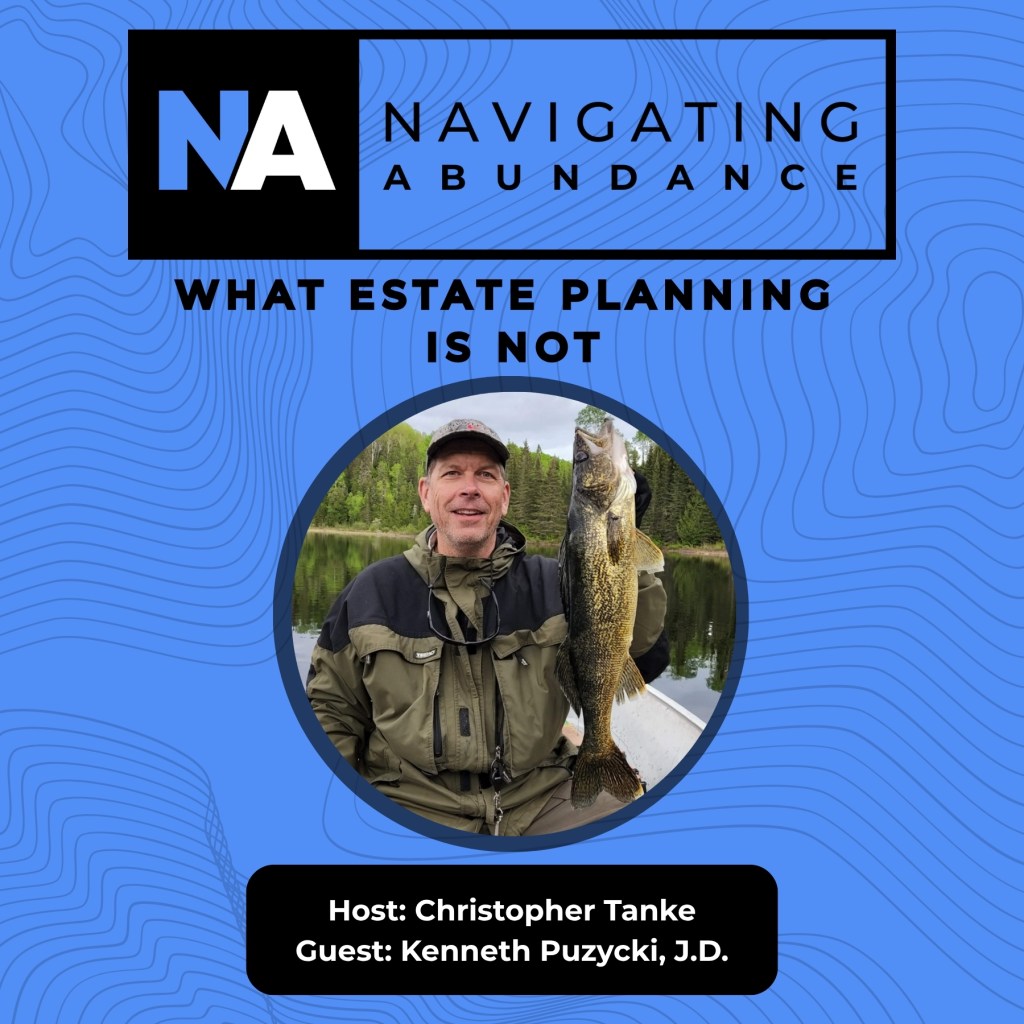
In this episode of Navigating Abundance, host Chris Tanke and estate planning attorney Kenneth Puzycki, J.D., discuss the complexities and misconceptions surrounding estate planning. They emphasize that estate planning is a process that requires ongoing attention and collaboration with trusted advisors. The conversation covers the importance of understanding the estate planning process, the need for continuous evaluation, and the impact of sudden wealth. They introduce the ‘5 D’s’ of estate planning, which include death, divorce, disability, dementia, and diagnosis, as critical moments to reassess one’s estate plan. The episode also highlights the significance of legacy wealth, family dynamics, and the role of charitable giving in effective estate planning.
If you’re interested in working with our guest, Kenneth Puzycki, J.D., click here: https://www.puzycki.com/
Click to Show Transcript
Chris Tanke (00:00)
Now today’s guest is Ken Puzycki of Puzycki Law here in West Michigan.
Ken has been an estate planning attorney for a couple of decades over here on our side of the state and has become a personal friend of mine, as you will see. We’ve worked on a variety of cases together and developed a really good friendship. Ken has a unique ability to take that which is complex and make it understandable or simple. And the law could use a little bit more of that. I’m sure you’ll agree. So I’m excited today for Ken. We’re going to be talking about a topic about estate planning, estate planning 101 maybe I would call it, but we’re coming at it from a little different angle. We’re going to be talking about what estate planning is not. What estate planning is not. And I think you’ll get a lot out of it. So thank you for tuning into this today.
Chris Tanke (00:48)
Ken, welcome aboard, my friend.
Kenneth Puzycki (00:50)
Thanks for having me. I enjoy it.
Chris Tanke (00:52)
It’s fantastic. Now, before we start, we have to talk about our fishing adventure in Canada. We just got back, what about 10 days ago up at Lake Nimbugasanda in Ontario.
Kenneth Puzycki (01:00)
Yeah.
Mentally, I’m still there, but that’s OK.
Chris Tanke (01:04)
Yeah, so I was able to share a week in a boat with this guy and we talked all things theological, all things financial, all things philosophical. Yeah, all things estate planning. It was a great time. We always wax elegant with each other. And I’ve got to say, Ken, you outfished me this year.
Kenneth Puzycki (01:21)
Well, it depends on the hour. You got me a couple hours there. I got you on small mouth bass. I’ll grant you that.
Chris Tanke (01:23)
Yes, yes. We, we, we found a, a really wonderful spot where we caught about 85 walleye in four hours. and we were just kind of doing jerk baits and stuff. It’s so much fun when they’re ripping it out of your hands, but then Ken got the bright idea. we got this. And so we went small mouth bass fishing and Ken was very successful. I was very frustrated to the point that I said, you know what? I’m just going to drive the boat. You catch the fish because all the rocks kept busting off my line and Ken knew how to avoid them and I knew how to find them and it was just horrible. So, Ken, Ken is the master small mouth guy. Yeah. Yeah. So, it was a great time. You got to get out there and enjoy your life. That’s the state planning rule number one, right? Don’t don’t wait for tomorrow. Live also for today. Enjoy every day. It’s a gift. So, so Kenneth,
Kenneth Puzycki (01:59)
They’re fun. They’re fun. That was a great time.
That’s right.
But plan for tomorrow, but don’t dwell on it. And that really is a good segue into estate planning 101. What is it? Yeah, there you go. You’re good. You’re You’re good.
Chris Tanke (02:18)
Yep, that’s right.
Well, that’s why I laid it out that way, Yeah.
All right, Ken, so why don’t you lead us into this journey of state planning a one-on-one sort of from the negative, and that is what it really isn’t. So I’m going to hand over the baton to you and pepper you with questions as we go.
Kenneth Puzycki (02:41)
Fair enough, I’ve got my flack jacket on. So I do a lot of talking in churches to church groups and nonprofit organizations. And it really surprises me what people perceive estate planning to be when in fact it’s not what they think it is. For example, a lot of people think that if they download a trust off the internet and sign it and date it, that they’ve got an estate plan.
And more fundamentally, if you ask somebody on the street, hey, what is, do you have an estate plan? And if so, what is it? They will say, I’ve either got a will or trust. And a will and a trust are certainly tools that help implement your estate plan. But the estate plan is a process. It’s a process involving me, involving you, involving tax advisors.
But it’s the establishment of a plan for the future and the documents themselves are really just tools to make sure that that plan is accomplished and in the wrong hands a trust can be dangerous or will can be dangerous just like a circular saw just because you own a circular saw does not carpenter make and just because you have a trust doesn’t mean you’ve got an estate plan. So a lot of people, again, part of the reason I’d like to talk to you today is to talk about debunking some of the myths about estate planning. In fact, I had an email this morning from a client saying, hey, we put all our assets in our trust. Are we protected against lawsuits if one of us gets into a car accident? A lot of people erroneously believe that if you have a trust, a revocable living trust, that you’re immune from lawsuits. And that’s absolutely not true. Having your assets in a revocable living trust does nothing to protect your assets if you get into a car accident or you get sued for something or other. So again, estate planning is a process. Wills are tools. Powers of attorney are tools. Medical directives are tools.
Trusts our tools and even beneficiary forms When you sit down with the client you help them roll their 401k over to an IRA Filling out that beneficiary form is one of the tools but altogether collectively all those tools Consistently they comprise the estate plan.
Chris Tanke (05:00)
Okay, so let me jump in right here. Because you use that word collectively, which was going on in my head as you’re describing all of this. I think that assumes some things that are super important. First of all, because of the complexity, because of the synergy, the interconnectivity of these things, you know, you got to be working with a trusted advisor. And this is not a plug. I’m just saying it’s the way it works with a trusted advisor who can understand how all those parts work together. That’s super. Yes.
Kenneth Puzycki (05:26)
I would say trust advisors, plural,
Chris Tanke (05:28)
Exactly right.
Kenneth Puzycki (05:29)
Because you might be making them 8%, 10%, 12 % a year on their investments, and that’s great. But if those assets end up going in the wrong direction when they die, that’s not so great. Or if they end up overpaying income taxes, that’s not a good thing.
Chris Tanke (05:40)
Yeah.
Yeah, exactly right. And we talk about the three areas of your wealth that you need to be thinking of total wealth concept. You know, your ledger wealth, your legacy wealth and your logistical wealth and your logistical wealth is your professional team that you’ve developed that they work together that they know each other and they all pull in the same direction. How critically valuable that is.
So valuable to this because the other part of this is laws change, life changes, situations change. So this is not a set and forget it thing. You’d best like the people you’re working with because you’re going to get to know them over the years because you just have to do that. is something that needs to be maintained, not just inked. Right? No, no.
Kenneth Puzycki (06:04)
Thank you.
That’s right. So you must be looking at my notes because that’s the next thing I was going to talk about is, that’s all right. That or you’re clairvoyant or just brilliant beyond your looks. I don’t know. But most people, when they say, I’ve got an estate plan, my wife and I did our estate plan 20, 25 years ago. We’re good to go.
The misconception there is it’s not a once and done. An estate plan is an ongoing process. Most people get an estate plan done, they start their estate plan when they’re young and they have kids. The purpose of which is to name guardians for their minor children. And then once the minor children are out of the house or near that point, then they start looking at probate avoidance and how do they protect their assets.
And then further beyond that, when they get in their 70s, 80s, 90s, then it’s an issue of, all right, how do we protect our assets in the event of long-term care? And you provide long-term care insurance for clients.
But it’s an ongoing lifetime process, just like our faith journey. Our faith journey is not going to Bible class when we’re eight or nine or 10 years old and calling, I had Bible class back when I was a kid. I’m good to go. No. It’s an ongoing process. It’s a river. And we just have to keep re-navigating it every step of the way. Because things happen. Things happen. Logs fall over the river, and we have to remove them.
Chris Tanke (07:34)
Mm-hmm. Yeah.
Yeah, exactly right. Exactly right. In regards to then, initially then if you pick and ask a few questions, I don’t know if we’re off your outline or not, right? But if I was asked a few questions, you know, if somebody
Has a sizable estate. Maybe they’ve backed into it. maybe they picked up a lottery ticket in the gutter and it struck, they had a large inheritance. had no idea it was coming their way. mean, sudden wealth happens. If, if somebody’s in that situation, all of a sudden, I, you know, we hear of it. I would imagine it’s true of most people. They’re going to be like a deer in the headlight saying, where do I begin with this? Because now all a sudden I have other, other issues, other concerns. If somebody sat down your office, whether a sudden wealth or not or had those kind of resources all of sudden I guess I would say what would be your advice for them as they begin the journey of starting to put together an estate plan.
Kenneth Puzycki (08:31)
It’s a loaded question and you knew it when you asked it but it’s a good question because every situation is different okay the more fundamental more fundamentalist question is when do you when should you call an advisor when should you call a lawyer when should you meet with your financial advisor when should you seek advice and
You know, every situation, some, you know, I do have clients who have come to me asking me to help them put together a trust estate plan. And they walk out of here with no trust at all because they can achieve their objectives with beneficiary forms. So every situation is different. We have what we call an EPO, an estate planning organizer, similar to the questionnaire that you send to your clients, so that I can help them develop a plan but I don’t I can’t help them develop a plan until I know what the family tree looks like. Is it a first marriage? Is it a second marriage? Do we have a Brady Bunch going on?
What are your assets? Are they the assets that you’ve earned? Are the assets that you’ve inherited? Does the dollar amount justify some sophisticated tax planning as well as estate planning? And again, a seasoned attorney will be able to guide the client through the process. Once you’ve dealt with a couple hundred or a couple thousand clients,
A good attorney will know what direction to guide the client in with the guidance of the financial planner and the tax advisor.
Chris Tanke (09:56)
Yeah, because that’s a very good question. And again, we’re freelancing this. So if there were four five things you want to talk about that estate planning is not I’m asking questions, I know I’m getting you off the rails. So if I could ask this now, maybe you could answer it later. With your logistical wealth team, right? You might have
8 or 10 or 12 or 14 different professionals all working for you together in either a family office or your virtual family office or whatever you’re Generally speaking, there has to be a quarterback. It helps a lot. And we’ve seen folks attempt that without one. Boy, is it a mess. Everybody works a lot harder if there’s not a quarterback. So if you can get, and this is key, your professionals to understand who the quarterback is and not have their feelings hurt. Well, I’m the family attorney. I should be the court. If you can have some humility, in other words, the client comes first and you choose that quarterback. Generally speaking, what have you seen as far as a successful position? Who assumes that role or who is ascribed that role?
How does that work out? Is it the advisor? Is it the attorney? Is it the CPA? Is it personality driven? How does that work?
Kenneth Puzycki (11:03)
It’s issue driven. It’s issue driven because if a client comes into a large inheritance or something, one issue is, how are you going to reinvest this money? Are you going to put in stocks, bonds, mutual funds? you going to put in a whole life policy? How are you going to do that? And a lot of times, we leave that in the hands of quarterback number one, which is a financial advisor.
If the person, for example, inherited an IRA or Roth IRA, obviously there are tax implications, in which case quarterback number two would come in and handle that snap.
And in terms of where is this stuff going to go at the end of the day when the client passes away, that’s where quarterback number three jumps off the bench and handles that snap. So really, there is no quarterback that does everything. It really depends on the issue at hand. But there has to be a coordination. There has to be a head coach that says, OK, this financial planning issue, we’re going to give that to the financial advisor. This tax issue, we’re going to give it to the CPA, the legal end of it give it to the lawyer and let him do his thing. So it really depends. There’s no one person is going to do everything. But the reality is somebody has to be able to point the finger and say, you do this issue, you do this issue, I’ll take the next issue. And a lot of times that ends up being the attorney.
Chris Tanke (12:06)
Okay, very good.
Kenneth Puzycki (12:21)
Because the attorney kind of has the big picture in mind. An estate planning attorney has to know something about finances. They have to know something about taxes. And obviously, they have to know something about the will or the trust in terms of how do you get the assets to the next generation.
Chris Tanke (12:36)
Mm-hmm. All right. Very good. Very good. So Kenneth, why don’t you, if you had a few things that you wanted to discuss today, because again, I’ve taken you off the rails. I’ve freelanced it with you so far. Let me come back to the things that you want to make sure that we cover or maybe we haven’t even done yet. And take us from here.
Kenneth Puzycki (12:52)
I’m going to make an assumption that whoever’s watching this discussion has some estate planning done already. Now whether that’s having everything jointly held with your spouse, that’s in the state plan or a portion of the state plan. If you’ve got beneficiaries on your IRAs or 401ks or life insurance, that’s part of the estate plan.
A lot of people probably already have a will or a trust. That’s part of the estate plan. I’m going to assume that everybody has some level of estate planning already in place. The follow-up question is, when should we have that evaluated or when should we re-evaluate the estate plan? Again, it’s not a one and done proposition. We’ve come up with a little jingle, we call it the 5 Ds.
Denver, Des Moines, Duluth, Detroit, and Dubuque. I’m kidding, of course. The five D’s, if there’s a death in the family, call somebody. Call me. I will point you in the direction. If it’s a financial issue, I’ll push you towards your financial advisor. But if there’s a death in the family, you should always call an advisor and say, hey, we had a death in the family. My spouse died, my child died, my parent died, my brother and sister died.
Do we have to do anything? And a lot of times the answer will be no. Everything’s already taken care of. But if there’s a death in the family and you might be receiving assets, that’s the time to sit down with the lawyer and figure out what to do with it and where you should go with those assets. So death is one of those critical life events where you should call an advisor. The second D is divorce.
If obviously if you are on the brink of a divorce, you need to call somebody real quick. But certainly if your children, if it looks like one of your kids might be in for a divorce, call your lawyer. Call your lawyer. If one of your children is looking at a separation or a divorce that is a critical time in their life, you need to make sure that the estate plan coordinates with an impending divorce situation. So we have death and divorce. The other one is disability.
And obviously, when we think of disability, we think of grandkids with Down Syndrome or Cerebral Palsy or other disabling conditions
Chris Tanke (14:55)
Yeah, the other interesting thing to consider too is if to expand this with disability, you’ve got a Gen one creator of a sizable business. And all of a sudden, you know, it’s we’re starting to recognize that there’s a little slippage here, mentally, boy, there’s a there’s a lot to be preparing for in that situation. Because if you let that go, of course, everything’s going to blow up. So so that
Kenneth Puzycki (15:17)
Absolutely. ⁓ As I ponder my own succession plan. Yeah, but it is critical. It is critical. And that kind of gets us to the next D, and that is dementia, especially for those business owners who, know, and again, I’ve had clients diagnosed with dementia as early as 51, 52 years of age. So it doesn’t just mean people that are old. ⁓ If there’s a memory issue or a health issue of any kind, again, that’s the time for either you, if you realize what’s happening to you, or your loved one, to call an advisor and say, dad’s starting to slip. I found his Rolex in the freezer again, and it scares me. And that’s where powers of attorney come into play.
Because if your loved one is starting to slip a little bit mentally or health-wise, you have to have somebody that you trust to kind of take over and help make sure things get straight again. So we’ve got death, divorce, disability, dementia. And then the last one is diagnosis. For married couples especially, if one spouse goes to the doctor and gets a terminal diagnosis, that is a huge, huge planning opportunity. Objectively speaking, if you know which spouse is going to die first, you can do some very, very effective planning, tax planning, financial planning, and estate planning. you may have had an estate plan done 5, 10, 15, 20 years ago, but if any of those 5Ds has happened in the intervening 5, 10, 15, 20 years, that’s a time to call either you or me or the CPA. One of the three of us will say, stop, we need to evaluate this and determine what course of action to take in response to that disability, dementia, or diagnosis.
Chris Tanke (17:01)
Yeah, it might seem very, very frank in some ways, even a little morbid to a field underwriting exercise on who’s going to survive who. But I’ll tell you what, these kind of honest conversations are just absolutely critical, absolutely necessary if you’re going to be able to give honest best solutions.
Kenneth Puzycki (17:19)
Absolutely.
I tell my clients, I apologize virtually every time I’m with a client because I tend to bring a little too much levity to the issue. I tend to err on the size of humor because unless you bring a little joviality to the situation, it can be very depressing.
Chris Tanke (17:27)
Yep. Yep.
It can be very heavy.
Kenneth Puzycki (17:37)
Very heavy. So and I’m very cognizant of that. And I temper my humor depending on the on the client, of course, but but it’s a it’s very important stuff. And as clients are going through these these life changing situations, it really isn’t coming upon us as advisors to lead the charge because they’re they’re going to be thinking about everything else that’s going on. And we kind of have to circle them back and gently bring them into focus on the financial issues so that the assets that they’ve worked so hard for don’t end up going where they’re not supposed to go.
Chris Tanke (18:07)
Yeah, for sure. For sure. that’s, that’s part of the fiduciary opportunity and and calling is to have those kinds of conversations to be very honest up front and try to and try to draw people out to tell you what they’re really thinking and what their concerns are. That’s that’s not always easy to do. And, and, but but, you know, that’s sort of like a physician doing surgery, that doesn’t feel good either. But by golly, it’s got to be done.
Kenneth Puzycki (18:24)
No, it’s not.
That’s right.
Chris Tanke (18:32)
And to address the elephant to the room sometimes You know that doesn’t always work real well when husband and wife aren’t on the same issue Anyway, and then I’m bringing up or you’re bringing it up, but it has to be brought up.
Kenneth Puzycki (18:40)
That’s right.
That’s right. And that’s where having a good team, everybody singing out of the same hymn book is critical because if the CPA doesn’t know what you’re doing, you don’t know what I’m doing, I don’t know what the CPA is doing, we’re doing our clients no service. In fact, we’re doing them a disservice by not bringing in those other professionals.
Chris Tanke (19:01)
Yeah, and especially if there’s egos involved that prevent that from happening again here coming back to logistical wealth, which we emphasize. That’s your professionals. It’s so important to have everybody play together. Well, it will pay off in spades because unless you do it, no good deed shall remain unpunished. I’m telling you that’s what’s going to happen. So.
Chris Tanke (19:18)
So it’s certainly worth going out to a lot of lunches and breakfasts and whatnot and getting to know people and sharing your heart and getting these folks together and getting them in a boat together, whatever the case might be, because it’s all about relationships. It’s all about trust. It’s all about synergy. That is earned. That doesn’t happen [automatically].
Kenneth Puzycki (19:35)
That’s right. That’s right.
That’s right. And the sooner in the process that those advisors get to know each other, the more freely that communication is going to take place. And at that point, the kids start getting involved too. A lot of my clients do not want to involve the kids. And I tell them, look, at some point, we need to bring the kids into the room. Because if they have no clue what’s going on, and mom and dad have a medical event or mom and dad die, that’s going to put those kids behind the eight ball. Those kids need to become part of the team. There are exceptions to that. you’ve got a drug addicted kid, you don’t want to bring them in, of course. But if you’ve got kids who you trust to be the successor trustees, to be the executors of the estate, my recommendation is bring them in early before they have to be put under pressure. That just makes things a whole lot easier here for the whole team if something should happen.
Chris Tanke (20:29)
And then this is this is the genius behind focusing on your legacy wealth, right, which is the most important of the three categories and and talk about family meetings, the way we communicate, the way we resolve conflicts. You know, what is our plan to develop those opportunities great in a greater sense? Because essentially, you know, nobody lasts forever. We’re all in the process of passing the baton.
How much better, although it could be work and it can be uncomfortable, but how much better to start doing some of that now rather than just saying, one day, you know, mom calls up and say, dad’s gone and now you’ve got all this, this mess. And I had opportunity. I had opportunity to make a difference, to build into my successor’s lives. And I just was too busy golfing or too afraid to address issues.
Kenneth Puzycki (21:13)
That’s right, that’s right.
Chris Tanke (21:13)
Yikes, that is that’s just a huge mistake. And I would suggest that for all the success that you had in in building your ledger wealth, pointed you drop the ball and passing it down to the next generation. mean, that’s crazy. We often say that even with investing because of the taxes of the United States, it’s not about what you make, it’s about what you keep after you make it. That’s very, very, very important. Same.
Kenneth Puzycki (21:33)
Absolutely. Yeah, and that’s that third school.
Chris Tanke (21:37)
It’s the thing with two of your state. It’s not about what you make. It’s about what you’re able to keep after you’re no longer here. You make it and you pass it along. You know, what is the end game? What is the long-term generational plan? Wow, how valuable is that? How valuable.
Kenneth Puzycki (21:48)
Right?
Absolutely. again, getting back to that third D, the disability. In that category, I include children who have other issues, gambling addictions, drug addictions, bad marriage situations. I’ve got half a dozen clients whose kids are in prison. When I sit down with clients initially, I talk about everything on the family tree. I go up the family tree, over the family tree, down the family tree, and every so often the client will, why are you asking me about this? Why do you need to know how many siblings I have? And I say, it’s important. need to be able to identify potential problems coming down the road so that if they do erupt, I’ll be ready for them. I need to know, have you been through an estate plan before? Are your parents living? Have you gone through the probate process before? If your child is married to somebody who’s got a drug addiction, I need to know about that. It’s not me prying. It’s not me prying. I’m not insensitive to that.
Chris Tanke (22:46)
Mm-hmm. Right.
Kenneth Puzycki (22:49)
But it’s a matter of knowing what those potential problems look like so that we can head them off at the state.
Chris Tanke (22:55)
Mm-hmm. Mm-hmm, which is where the frank honest conversation comes in all over again I tell people I’m not doing this to be nosy. I’m not getting up in your business, but you’re here for my best advice I’ve got to ask you three more questions
Kenneth Puzycki (23:00)
Right [we] can’t give our advice if we don’t have a good understanding of the underlying facts. We just can’t. If that’s what they want, they can go to Barnes and Noble and grab a trust book off the shelf. But that’s not an estate plan. Again, Back to the what is an estate plan. It’s not a book that you get from Barnes and Noble that you fill in the blanks and sign in the presence of two disinterested people. That’s not an estate plan. That’s a part of the plan.
But if that’s what you consider to be your plan, you’re going to be terribly disappointed.
Chris Tanke (23:36)
But legal zoom can do it for so much less money, Ken. And it takes so much less time.
Kenneth Puzycki (23:39)
Yeah. Mr. Shapiro. Yeah, that’s, yeah. Again, they’re all about the almighty buck, but there, you know, there’s no teamwork involved at all. You’ve got to have an advisor who’s been through this a couple thousand times to know what the potential pitfalls are, so that they can help you avoid those pitfalls and achieve your objectives.
And so we start out by identifying the objectives. I’ve got clients who are worth 10, 12, $15 million. And I ask them point blank, do you really want to leave all of this money to your kids? Or would you like to leave some to charity and leave that legacy? Or do you want to leave it to all of your kids? Or do you want to jump over the kids and put some of that money in an education trust for the benefit of your grandkids? We help them develop that focus so that we can help them develop the estate plan that achieves their objectives. And identifying those objectives is a big part of that puzzle. Because if we don’t know what their objectives are, any plan will do.
Chris Tanke (24:35)
Mm-hmm.
Right. That’s exactly right. And the money and the assets and the resources are the how, but the what that’s where your, logistical wealth team comes in place. You know, why are we doing this? What’s the purpose? What’s the goal? What do we want to want to, what do we want to see happen? Yeah.
Kenneth Puzycki (24:50)
Right? Yeah, what’s the end game?
Yeah, what’s the end game? If you want to leave your kids a bunch of money, you can name them as a beneficiary on all your assets, but is that really the ultimate objective? Most people would say no, we don’t want our children to lose their inheritance in the event of a divorce. We don’t want all the money to go to the great grandkids at age 18. We want the money to be used for good things. And that’s where a properly drafted trust will help them put together a plan so that that money ends up going where they want it to go and in the manner in which they want it to go. And then there’s the charitable end of things. With qualified charitable distributions, people have become much more charitable. In my experience, now that we have qualified charitable distributions from IRAs, a lot of people are having a lot of fun with it.
They make their RMDs out of their IRA and they get to take advantage of the $30,000 standard deduction for a married couple. They love that because they’re getting at the IRS. If they can join arms and try to save money tax wise, they have fun with it. They treat it like a game and it can be done.
Chris Tanke (25:54)
Right. Yep. Yep. And we have quite a few clients that are living so far below their means, but it’s sport. They like it. They’re trying to disinherit Uncle Sam because they’re convinced that they can spend or their children could spend the money more intelligently or well, more morally. And so, and that’s it. you’re, however many dollars that you have, really it’s all about utilizing those assets in a way that’s going to do the best good. And you have a lot of things to consider like can your children handle it? Right? Is it too much? Is it not enough? Or how do you disinherit the government? Or how much should you give away and how are you going to give it? And how do you I would even say in that respect?
How do you create a legacy of giving so that your finances are being directed intelligently even when you’re no longer here? Can you build that in and of from your family? A lot of great things that you can do. But again, it takes work. You’re not gonna do this in a weekend. And it takes money. This is not cheap to do. But wow, compared to the alternative, it’s so much more effective.
Kenneth Puzycki (26:48)
Right? Yeah.
Yeah, and let’s face it, what we have and what our clients have doesn’t belong to us or them anyways. They’re stewards. What is our job? We’ve been blessed with a lot of wealth. We were born into this society. We’ve got more wealth than 95 % of the entire world. What is expected of us? We have to be stewards with that money.
Chris Tanke (27:01)
That’s right. That’s right.
Kenneth Puzycki (27:14)
Don’t give more to the government than you have to. Don’t dump it on your kids if they’re just going to burn it away and retire at 32 with their inheritance. A lot of different factors go into that. And it’s multifaceted, and that’s why we have multiple advisors to help the client achieve their objectives.
Chris Tanke (27:30)
Right. All right, Ken, as we circle around for a landing now, did we hit everything you wanted to cover? we hit the things you need to consider in regards to estate planning not being? I think this is sort of like estate planning by jazz. I mean, we went all over the place, which is fun, but I think I might have gotten off your outline. I feel bad about that.
Kenneth Puzycki (27:40)
I think, yeah.
Well, like when I do these seminars at churches and nonprofit organizations, I give people outlines. I tell them, we’re not going to follow it, but we’ll hit all the boxes. And we’ve hit all the boxes in the short time that we’ve been talking this afternoon. I would like to hammer on the powers of attorney and medical directives a little more, but we’ll save that for another talk.
Chris Tanke (28:01)
Good.
Yeah, that would be good. And you could give us maybe some positive stories and of people that have done that and the impact the difference it made in their hour of need. And that would be good too. Well, yeah, there’s some negative ones.
Kenneth Puzycki (28:16)
[I’ve] got enough negative stories.
Chris Tanke (28:24)
Well great well Ken thank you so much for spending some time with us today I sure appreciate you being here and carving out some moments here out of your busy schedule and we certainly will in our show notes have contact information people want to get a hold of you but if somebody just would like to talk to you and has a pen in their hand right now what would you have them jot down for them to connect with you?
Kenneth Puzycki (28:45)
Well, my phone number is 616-738-8800. That way you don’t have to remember how to spell my name. So 738-8800. And there are other attorneys in the office who do what I do, very trustworthy attorneys, and we’ll be glad to sit down with whomever wants to talk and help them through the process.
Chris Tanke (29:04)
Very good. Well, again, Ken, thank you so much for spending time with us and thank you, the audience, for listening. We hope that you gained at least maybe one or two nuggets. Maybe you had 80 % of this down already, but boy, there’s a couple of things we need to pursue. Well, God love you. That’s exactly what you should do. And that’s what we want to do is to prod you onto making right decisions. So until then, this is Chris Tanke with Navigating Abundance reminding you once again, your family is worth it.
 Navigating Abundance
Leave a comment